EMILY SCHOPFER
By Emily Schopfer
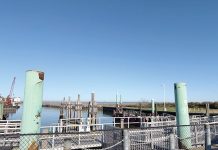
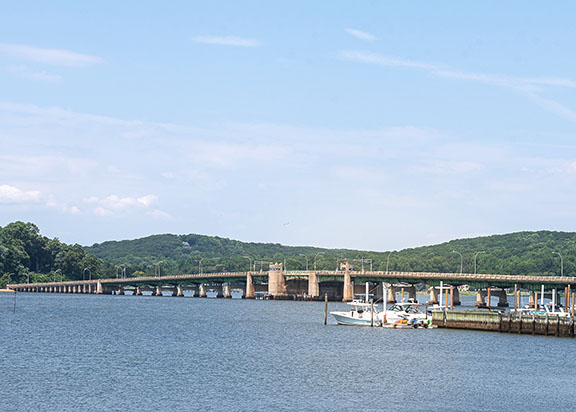
MIDDLETOWN – A public information and comment session on design and construction plans for the county’s Oceanic Bridge will be held Sept. 29, more than a year after the project entered the preliminary engineering phase. The bridge connects Rumson and Middletown, over the Navesink River.
County officials will hold the session from 6 to 8 p.m. at the Middletown Township Municipal Building on Kings Highway.
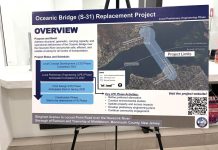
According to the North Jersey Transportation Planning Authority (NJTPA), the meeting will update the public on the project status and schedule, present “preliminary design plans and enhancements” to the preferred alternative established during the local concept development study phase, and solicit public input. Notice of the meeting was also on the Oceanic Bridge (S-31) Replacement Project’s official county website, monmouthcounty-oceanicbridge.com. According to website announcements, the Sept. 29 meeting will be the first public information meeting since Aug. 27, 2020.
The current bridge connects Bingham Avenue and Locust Point Road. Originally constructed in 1939, the U.S. Department of Transportation (DOT) classified the bridge as structurally deficient in July 2021. Reports from the DOT’s National Bridge Inventory (NBI) estimate that about 23% of the county’s 508 bridges need repair and 10% are structurally deficient.
The Oceanic Bridge is 87 years old and “has structural and functional limitations that do not meet today’s design standards,” accord- ing to the project’s official website. “Due to its age, the bridge has deteriorated over time, and routine maintenance can no longer address the deficiencies.”
The Oceanic Bridge website also states that the bridge is “structurally deficient (poor condition), functionally obsolete (sub-standard geometry), and nearing the end of its service life,” noting heavy rust, corrosion holes and “wide cracking; deep spalls; exposed and severely rusted reinforcing steel; deteriorating steel pile jackets; and exposed steel H-piles” (long structural beams). In past years, the drawbridge element of the bridge has also frequently suffered mechanical failure during the summer months, causing it to stay open.
The debate is not whether the 2,712-foot-long bridge needs to be replaced. Rather, it’s the replacement bridge’s vertical clearance that has been debated since at least 2019.
When closed, the draw-bridge’s navigational clearance sits 22 feet above the water at mean high tide. However, on the U.S. Coast Guard’s recommendation, the new bridge could have a vertical clearance as high as 65 feet. A Preliminary Determination of Navigational Clearance Letter was issued by the U.S. Coast Guard (USCG) in March 2019. The letter confirmed that a movable bridge would need 22 feet of vertical clearance, but a fixed bridge alternative “must be at least 65 feet.”
This clearance would result in a roadway height of 81 feet. County officials and community members have pushed back. If the new bridge is fixed, the county has advocated for a 50-foot clearance, according to an April 30, 2021, letter from the Department of Public Works and Engineering.
Local officials also provided input. In an April 12, 2021, Two River Times article, Middletown Mayor Tony Perry said a vessel survey concluded that, out of the about 516 vessels that went under the Oceanic Bridge on a given day, only five vessels needed a 65-foot clearance.
But local officials, and even county officials, do not have the final say; the USCG does. As a result, former Gov. Phil Murphy requested in a Sept. 22, 2022, letter that the Coast Guard reconsider its decision on the proposed bridge’s height and design.
The project has been in the Local Preliminary Engineering (LPE) phase since April 2025. In fall 2024, county officials awarded a $4.9 million preliminary engineering and design contract to Michael Baker International. The LPE phase is fully funded by a $4.97 million federal grant awarded in February 2025. The final cost for the entire replacement project will be determined by contracts awarded after the project goes out for bid and will depend on whether officials opt for a fixed or movable bridge.
More recently, the Monmouth County Board of County Commissioners released an Aug. 4 letter to the public with project updates. “We recognize that this has been a lengthy process for many residents, commuters, and local businesses, and we appreciate your continued patience and co-operation as this critical infrastructure project moves forward,” the letter, signed by Commissioner Director Thomas A. Arnone, said. As of Aug. 4, the letter says land survey and base mapping efforts are complete. Additionally, various Technical Environmental Studies (TES) are underway, including those relating to hazardous waste, threatened and endangered species, ecology, road noise, air quality and more.
According to the project website, each phase of the project was projected to take two years from start to finish. With this projection and no setbacks, the project will move into final design by spring 2027, with construction breaking ground sometime in 2029, and completion in 2031.
This article originally appeared in the September 24 – 30, 2026 print edition of The Two River Times.