By Sunayana Prabhu
RED BANK – The planning board recently approved an “area in need of rehabilitation” designation for a cluster of properties, excluding the current Atlantic Club parcel, at the site proposed for developer Roger Mumford’s townhouse development.
The proposed Carpenter’s Village development will include “stacked” townhomes, with 14 affordable housing units. The developer plans to build a Second Empire-style (typically with mansard roofs) townhome community to capture some of Red Bank’s architectural character.
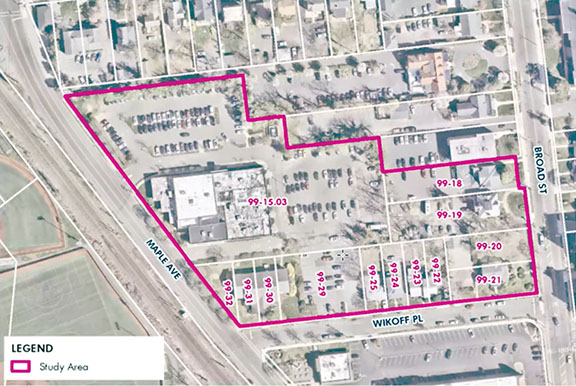
The majority of the 5.5-acre tract wraps around Maple Avenue (Route 35), Wikoff Place and Broad Street, just north of the former Super Foodtown location. The area comprises three single-family homes, the historic “Mushroom House,” the former Carpenter’s Union building, a few businesses and the Atlantic Club. Mumford purchased about 15 properties on the mixed-use parcel, including the Atlantic Club, which occupies about 60% of the overall proposed site.
The board decided to withhold rehabilitation designation for the club because it was deemed in good condition. That also means that the parcel will be excluded from any tax benefits applied to properties with rehabilitation designation.
Mumford purchased the Atlantic Club property in May. The health club operates under lease by Genesis Health Clubs, a major private gym operator. It will relocate across Wikoff Place to the shuttered Super Foodtown store. The former Foodtown corridor at the tip of Maple Avenue and Broad Street is not part of Mumford’s proposed development but the two holdings share about 700 feet of common boundary, which could allow for shared improvements that benefit both the residential community and the fitness club.
Susan Favate, the borough’s planning consultant, explained that a rehabilitation designation differs from a redevelopment designation, which allows eminent domain. A rehabilitation designation can make properties eligible for tax abatements or exemptions for up to five years.
Favate presented the area study and said most of the adjoining parcels fit the criteria for rehabilitation designation. “Overall, there’s a continuing pattern of vacancy, abandonment and underutilization,” Favate said, listing the conditions of most of the existing buildings.
Favate noted that the Atlantic Club was active and its building and parking areas were also in good condition. “There’s clear evidence across the study area, with the exception of the Atlantic facility, of general substandard and deteriorated conditions, discontinuance and abandonment,” Favate said. “It’s my opinion that all of the lots except for the Atlantic Club property meet this (rehabilitation) criteria.”
The board spent most of the meeting debating Atlantic Club’s exclusion from the rehabilitation designation.
Board member Megan Massey argued that if the board approved a rehabilitation designation for the club, it would “set a really bad precedent.” She said the process could reward an owner who allowed most of the properties to deteriorate or fall behind on taxes by making it easier for a prospective developer to secure rehabilitation area designation and potentially receive a five-year tax exemption.
“The five-year tax abatement, that’s up to the tax assessor. That’s technically not up to council,” Shawna Ebanks, the borough’s director of Community Development, Planning and Zoning, said. Favate added that a parcel’s eligibility for a rehabilitation designation does not mean an abatement will automatically be granted.
“I would encourage code enforcement to pay more attention to properties that are being left to deteriorate, so that people can do exactly what this owner is doing, which has happened before in town,” board chair Dan Mancuso said.
“I don’t think the Atlantic Club meets the criteria,” Mancuso added. “I am thoroughly against rewarding property owners (for) letting their properties just go derelict in hopes of getting some kind of satisfaction, whether it be from the mayor and council or a land use board, for that action.”
Board member Barbara Boas voted against the entire proposal, even with the exclusion of the Atlantic Club. Boas was concerned that some of the structures, like the Carpenter’s Hall building, could have historical significance. “I really have a hard time justifying taking a block of ground that is so different and so diverse, and putting it into one big pile,” Boas said. “I feel that this is just a backdoor sneaking into an eminent domain kind of a situation and it really bothers the bejesus out of me, truthfully.”
The planning board’s recommendation, made during the Oct. 28 meeting, will now be reviewed by the borough council, which will decide whether to adopt the plan.
While the board ultimately recommended that the study area met the criteria for rehabilitation, the recommendation is not approval of Carpenter’s Village. The borough council will make that decision; the upcoming development plans would still require a round of planning and zoning board approvals.
Additional projects built by Mumford in town include the recently completed Azalea Gardens townhome community on the corner of Harding Road and Hudson Avenue, the Brownstones townhouse development on Catherine Street, Station Place apartments on Monmouth Street and Oakland Square apartments on Oakland Street. He also developed the Fortune Square apartments on Drs. James Parker Boulevard, which included the restoration of Maple Hall, now the T. Thomas Fortune Cultural Center.
This article originally appeared in the November 12-18, 2026 print edition of The Two River Times.