By Stephen Appezzato
Amid bipartisan pushback, Gov. Phil Murphy doubled down on his commitment to bring renewable energy to the Garden State, partly through offshore wind turbines. Whether it is “clean” energy or not is debated by many.
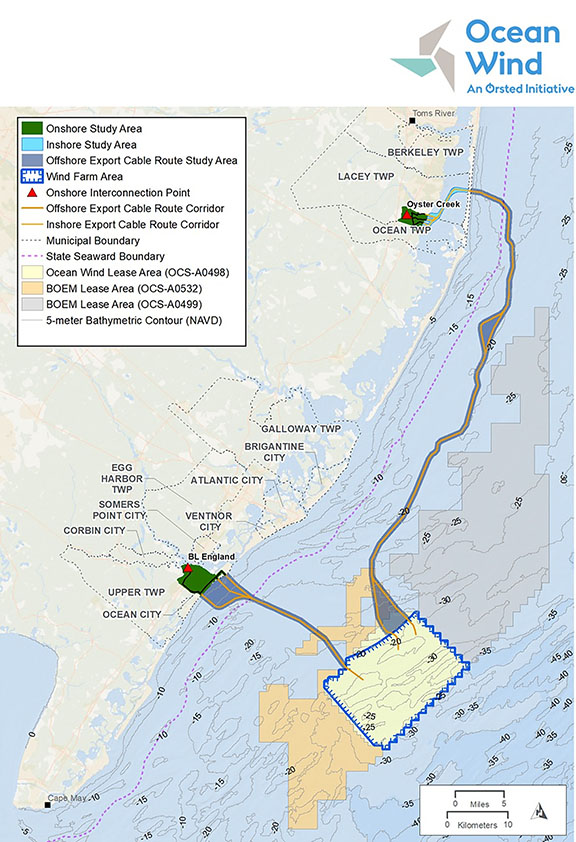
On July 6, Murphy signed Bill A5651/S4019 into law, granting one wind developer ownership of federal tax credits that were originally intended for ratepayers. In one estimate by state Sen. Edward Durr (R-3), the value of the credits nears $1 billion. The decision to pass the legislation came one day after President Joe Biden greenlit the Ocean Wind 1 project, a wind farm located 15 miles off the coast of Atlantic City.
The tax benefits were initially codified in the Tax- payer Certainty and Disaster Tax Relief Act of 2020, legislation passed during the economic turmoil faced by many amid the onset of COVID-19. The original purpose of the federal funds was to offset expensive utility bills for customers.
So, why did nearly $1billion shift hands from New Jerseyans to Ørstead, the Danish multinational energy company constructing Ocean Wind 1?
According to Ørstead, it was a much-needed influx of funds to combat high interest rates and inflation brought on by the pandemic and geopolitical challenges, such as the war in Ukraine. Without the federal benefits, the company was unsure Ocean Wind 1 would be profitable enough to continue the project. If Ørstead were to pull out, it would be a big hit to Murphy’s long-term commitment to clean energy in the Garden State.
“We need to adjust and recognize these issues in order to help the offshore wind industry, which is New Jersey’s greatest clean energy and climate solution, get off the ground and effectively takeoff,” said Anjuli Ramos-Busot, the state chapter director for Sierra Club.
Critics note that Ørstead achieved record profits last year and even acquired its previous partner Eversource’s stake in their offshore lease in May, valued at $625 million.
“Clearly Ørstead isn’t ‘strapped for cash,’ ” said Cindy Zipf, executive director of Clean Ocean Action, a local nonprofit that works regionally and nationally to protect waterways. “Now, New Jersey taxpayers will pay even more for Ørstead’s offshore wind project which is also putting our ocean resources at risk,” she said.
Lawmakers on both sides of the aisle, as well as many advocacy groups and residents, contested the legislation that allocated the federal tax benefits. In the assembly, the bill passed with a vote of 46-30; in the senate 21-14. All state lawmakers from districts 11 and 13, covering many Two River area towns, voted against the bill.
“The company, Ørstead, made record profits last year – $4.4 billon. This felt to me like a corporate welfare giveaway,” said Sen. Vin Gopal (D-11) in an interview with The Two River Times. “It’s going to be on the back of ratepayers and I felt they (Ørstead) needed to do a lot more explaining and there were still a lot more concerns.”
“I generally don’t support large corporations getting big tax breaks if they can’t provide the value and show the value. For me they (Ørstead) didn’t make that argument. That’s why I didn’t vote for it,” Gopal explained.
In the period leading up to the bill’s passage, those opposing offshore wind projects along the Jersey Shore were determined to halt the developments.
U.S. Rep. Chris Smith of New Jersey’s fourth congressional district pushed the Government Accountability Office, a congressional watchdog, to launch an investigation into the impact of New Jersey’s offshore wind development on the environment, fishing industry and more.
Clean Ocean Action urged residents to act by contacting officials, and reported timely updates on offshore wind developments over the past month as government agencies held public hearings.
“The public is largely in the dark and it’s a top-down fast-tracking government action that lacks science, due diligence and good governance,” said Zipf.
Currently, wind projects in New Jersey’s jurisdiction are slated off the coast of Atlantic City, with energy export cables running north along the shore to transmit power to substations.
Empire Wind, an offshore project in development off the coast of Monmouth County and Long Island is in New York’s jurisdiction.
Ørstead’s Ocean Wind 1 is the largest offshore wind project in progress along the East Coast. Projections indicate that Ocean Wind 1 will produce 1,100 megawatts of energy yearly, powering 380,000-500,000 homes. The company plans to have its turbines – also called monopiles – installed in 2024 and operational by 2025.
Atlantic Shores, another company seeking to build a wind farm off New Jersey’s coast, echoed Ørstead’s plea for government funds just before the passage of A5651/S4019. Murphy, committed to bringing the industry to the state, said he was open to Atlantic Shores’ request.
Multiple energy giants have large stakes in offshore wind companies. Shell New Energies has half-ownership of Atlantic Shores, while Empire Wind is owned by BP and Equinor. “The fact is, fossil fuel companies own offshore wind projects and they are getting passes, including tax credits,” said Kari Martin, advocacy campaign manager for Clean Ocean Action. “It’s time people get informed and speak up for the ocean,” Martin said.
Offshore wind farms have existed since 1991, when the Danish government commissioned Ørstead to construct the first farm, Vindeby, following the oil crisis of the 1970s. Since Vindeby, which originally powered 2,200 Danish households, more countries have commissioned offshore wind projects with the progression of turbine technology and efficiency. Vindeby was decommissioned in 2017.
The United Kingdom, Sweden and the Netherlands were the next to construct these energy systems throughout the 2000s. In the past few years, governments in India, South Korea, Taiwan and the U.S. have moved toward offshore wind, as the progressing technology has become more cost effective than other energy options and projects have a shorter lead time.
The topic of offshore wind farms is contentious among New Jerseyans.
Those against such projects warn of the impact on the ocean, its wildlife, and the boating, fishing and tourism industries.
Those in favor argue it is an effective way to aid in transitioning to clean energy, while bringing a valuable industry and thousands of high-paying jobs to the state. Sierra Club, a grassroots environmental non-profit with chapters across the U.S., supports offshore wind off the Jersey Shore, promoting environmentally and socially responsible execution of the projects. The organization points to the positive environmental impact and creation of high-paying “green jobs” as pull factors. According to the Sierra Club, New Jersey is one of the fastest warming states in the country, with a higher sea-level rise than the rest of the East Coast. Bringing offshore wind energy to the state would help mitigate climate change and help deliver on Murphy’s renewable energy goals. According to Ramos-Busot, offshore wind is “New Jersey’s greatest clean energy and climate solution.”
Another group, the American Littoral Society (ALS), a coastal protection organization, acknowledges the benefits of offshore wind’s clean energy, but emphasizes the importance of careful planning to protect wildlife and the people who rely on the ocean for their livelihood. “The acceptance of offshore wind farms in the Mid-Atlantic region hinges on where they are sited and the support of all parties that use these waters,” said Helen Henderson of the ALS in a release.
In June, a rally for responsibly developed offshore wind was held in Long Branch. Hundreds of members from environmental groups, labor and community organizations joined local and state officials to advocate for the projects.
The article originally appeared in the July 13 – 19, 2023 print edition of The Two River Times.