By Stephen Appezzato
After decades of work restoring birds of prey populations, state officials believe osprey and bald eagles have made a comeback in the Garden State.
This month the state Department of Environmental Protection (DEP) proposed de-listing these two species from its endangered species list, signaling these birds have recovered to the point where their survival in New Jersey is no longer in jeopardy. The move will be made official in a rule pro- posal that makes additions, deletions and conservation status updates to the DEP’s endangered species list, which also restructures the list to guide legislative intent.
“There are so many threats to these birds, even among the great conservation success,” said assistant director of the American Littoral Society Lindsay McNamara. The society, founded in 1961 and based on Sandy Hook, leads conservation, education and advocacy efforts to protect marine life and habitat.
In the mid-20th century osprey and bald eagle populations were devastated by the widespread use of DDT, a popular synthetic insecticide developed in the 1940s. DDT had lasting effects on the food chain as it accumulated in fish, which birds of prey ate. As a result, the chemical weakened eagle and osprey eggs, making them thin and brittle and unable to withstand incubation. The insecticide also contributed to acid rain in the region, which weakened nested eggs. “What was happening was the birds were laying their eggs, but the eggs were so fragile because of the chemicals that when the parents would sit to try to incubate, the eggs would just break,” McNamara said. “The population wasn’t sustaining themselves because the birds weren’t reaching a fledgling age.”
With the decline in bird populations, people began to advocate for a DDT ban. “We had been involved, way back, in fighting to ban DDT,” McNamara said. The substance was eventually outlawed by the federal government in 1972.
But DDT, coupled with rapid development and habitat destruction, had lasting impacts on bird populations. According to the DEP, in the 1970s and early 1980s, only one bald eagle nest in a remote part of Cumberland County remained in the state. Similarly, only about 50 osprey nests remained.
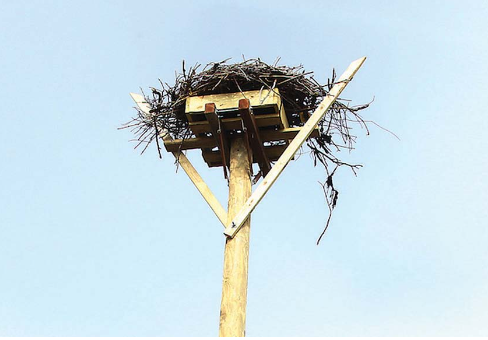
The near extinction of these birds in New Jersey sparked an effort to restore bird populations in the state through various strategies. Over the decades the Littoral Society and other environmental groups installed osprey nesting platforms along New Jersey waterways to promote bird nesting.
“You’re looking to make sure that they’re sited properly and the preferred habitat for the birds – the height’s important,” McNamara said. “Sometimes you’ll see what kind of looks like a silver wrapping around the base of the platform and that’s so raccoons and other predators can’t climb up the platforms and eat the eggs,” she said.
Biologists also began bird hacking, the practice of relocating healthy young birds to areas of decline to restore population growth.

“That’s a technique that’s been used on not just birds of prey, but other birds as well, with some success kind of in the mid-Atlantic, which is pretty interesting when you think about it,” McNamara said. Ultimately, conservation efforts were successful. In 2023 New Jersey had a record 267 nesting pairs of bald eagles and 800 occupied osprey nests.
McNamara said the Littoral Society was delighted over the comeback of these animals, but “we want to make sure that any (legislative) changes don’t put them in jeopardy once again. And so we’re recommending downlisting the osprey and bald eagles, but not removing them from the list entirely.”
With the resurgence of bald eagles and osprey, birdwatchers and residents will have more opportunities to see these powerful and remarkable species. However, it’s important to remain protective of these animals, McNamara said. The conservationist and lifelong bird watcher recommended viewing these animals from afar, as not to disturb them.
If you’re looking for the signs, “most birds will tell you when they’re agitated,” she said. “If a bird is looking right at you, it’s noticed you, (and) you might want to take a couple of steps back.” Birds who feel threatened may also defecate or vocalize. Conservationists avoid encroaching on these animals so they can conserve energy for catching food, feeding their young and rearing the next generation.
If a birder notices a silver (federal) or red (state) band around a bird’s leg, it designates the bird is monitored by a banding station. Using binoculars or a zoom lens, a number can be located on these bands and reported to a bird banding station for conservation data.
The DEP is accepting public comment on its osprey and bald eagle de-listing proposal through Aug. 2.
The article originally appeared in the June 13 – June 19, 2024 print edition of The Two River Times.