By Sunayana Prabhu
RUMSON – In a world of instant messaging, emojis and even AI-generated love letters, Lauren Marrus is placing her bet on something quieter and deeply meaningful: the art of the handwritten note.
“A text is gone in a minute,” Marrus said. “A handwritten note lasts forever.”
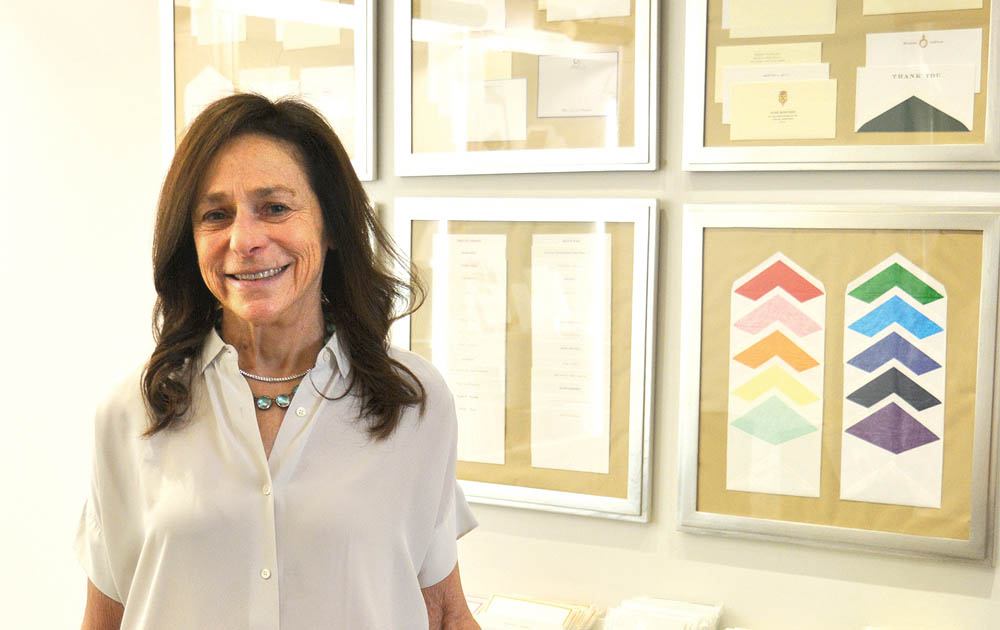
That belief has guided the Rumson resident through an unlikely career pivot from the fast-moving worlds of technology, finance and digital media to the tactile craft of engraved stationery. Today, she is the CEO and owner of Dempsey & Carroll, a 148-year-old luxury paper company in Manhattan that she rescued from bankruptcy in 2004 and rebuilt into a profitable, modern brand rooted in old-fashioned correspondence.
To Marrus, handwritten notes are not nostalgic relics. They are tools for connection in a culture she sees as increasingly fleeting. Words written on paper, “stand apart from the digital noise,” she said, describing the charm of a handwritten note. “You might leave it on your desk, and then stuff piles up on top of it but then a couple weeks later, you clean your desk, and you find the note again, and you smile all over again.”
Founded in 1878, Dempsey & Carroll has long been known for its thick cotton paper, engraved cards and elegant monograms. But when Marrus acquired the company, it was struggling. Revenue was modest – under $10 million – and its customer base was aging.
Her background did not suggest she would end up running a historic stationery house. A Harvard Business School graduate, Marrus built her career launching online services and working with financial information startups. She led digital initiatives at ABC and later founded an e-commerce paper business. Buying a traditional paper company seemed counterintuitive, even risky. But Marrus recognized something others overlooked: the strength of the brand itself.
“The quality of the craftsmanship and the deep library of designs that they had was, for me, a chance to be part of the history behind the heritage brand and a chance to shape its future.”
Within weeks, Marrus and her team built a simple website to accept orders – a forward-thinking move in the mid-2000s, before platforms like Shopify made e-commerce routine. Then she reconnected the company’s old toll-free phone number.
Soon, calls began coming in from longtime customers who had no idea the company was defunct for nearly six months. Those loyal clients helped carry the business from bankruptcy to profitability within months.
Still, survival required more than reopening the phones. Marrus needed to attract younger customers raised on smartphones, not engraved calling cards.
Her early marketing leaned on digital newsletters and, later, social media. Instead of treating technology as the enemy, she used it to amplify a very analog product.
Marrus admits some communications are simply better suited for text messages. Dinner plans or quick updates do not require heavy paper stock. But for moments of gratitude, sympathy or celebration, “digital just isn’t as meaningful,” she said.
But ironically, the explosion of digital communication has helped her business. “We have more people writing more notes because they want to stand above the digital noise,” she said. The company has developed several social media hashtags, such as #makingtraditionsmodern, and uses brand ambassadors to boost its business. She also encourages clients to share online the notes they’ve sent and received. You may get a note that’s “so cute that you have to post it,” Marrus said. “You can’t ignore it (digital media). To ignore it would be to die.”
Dempsey & Carroll’s most popular product remains simple: a personalized flat note card printed on substantial paper with a name, initials or small motif. Marrus calls it the “pillar of a stationery wardrobe.” Customers can choose colors, type styles, envelope linings and decorative edges. The cards become thank-yous after weddings, follow-ups after interviews or other small gestures of meaning.
Beyond bespoke orders, the company sells boxed cards, including a minimalist design with a red heart and a lined envelope, as well as collaborations drawn from its deep archives. One recent partnership with fabric and wallpaper house Schumacher revived a vintage dragon engraving, pairing it with a patterned envelope liner.
Marrus said the business is more than just paper goods; it’s about “gracious living.”
“Not rules or etiquette, but kindness – making people feel welcome and seen,” she said, whether that is a handwritten note after a meeting, a little place card at the dinner party, a nice pen gifted at graduation, along with a set of note cards. “Just things that help our clients elevate their world and the world around them.”
Over its nearly century and a half in business, Dempsey & Carroll has attracted high-profile clients – actor Katharine Hepburn, owner of New York Yankees, George Steinbrenner, and several others from the worlds of fashion, film and design – and continues to do so.
Fashion designer and filmmaker Tom Ford is among them. Marrus recalled that Ford featured Dempsey & Carroll stationery in his film “Nocturnal Animals,” deliberately holding a sheet up to the light so the watermark was visible on screen. “That was a super cool moment,” she said.
Marrus admits she has saved nearly every handwritten note she has ever received. Most clients, she said, do the same. Dempsey & Carroll cards are “rarely thrown out.”
Running a luxury paper company is not without challenges. Tariffs and supply chain disruptions have increased costs for domestic manufacturers, squeezing suppliers and lengthening lead times. But Marrus remains committed to quality, sourcing watermarked paper milled in the United States and maintaining traditional engraving methods.
For Marrus, the future of communication may be digital. But its most meaningful messages, she believes, will always arrive in an envelope.
The article originally appeared in the February 12 – 18, 2026 print edition of The Two River Times.