The Ukrainian art of Easter egg decorating is explored in an Atlantic Highlands workshop

By Eileen Moon
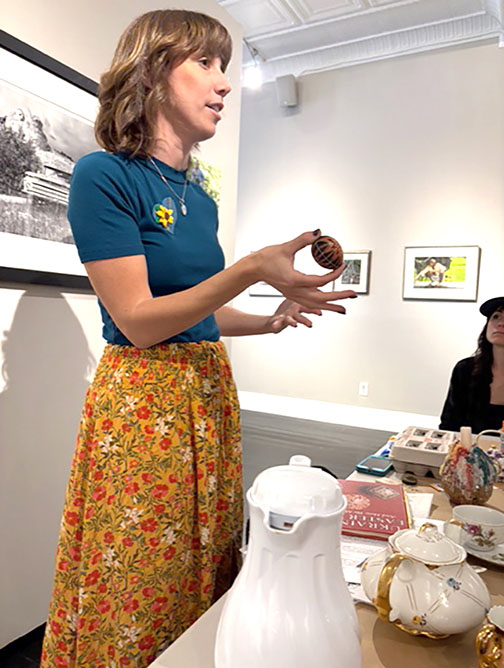
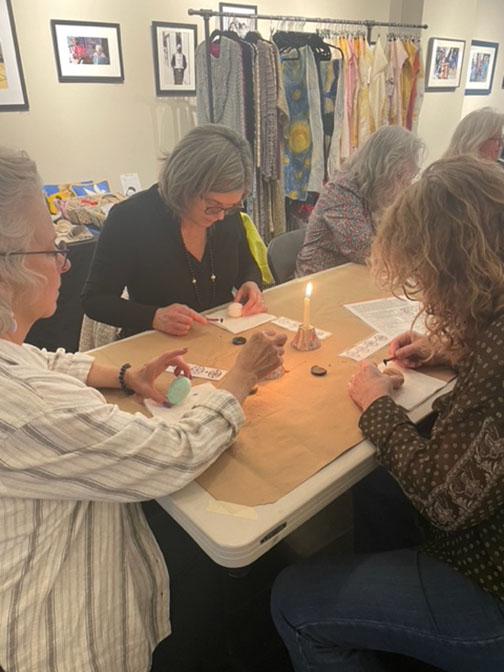
ATLANTIC HIGHLANDS – On Saturday, March 30 – the first warm day of the newly hatched spring – an adventurous group of men and women gathered at the Atlantic Highlands Arts Council to participate in a hands-on workshop titled “Pysanky for Healing,” led by professional artist Jenny Santa Maria.
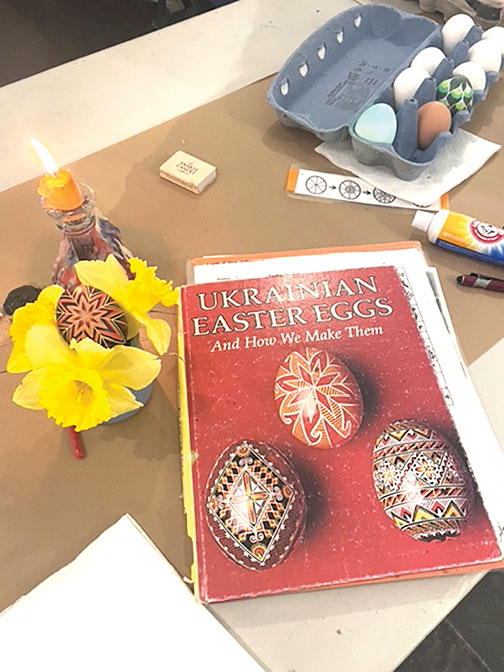
Pysanky is the Ukrainian word for hand-decorated Easter eggs, a word derived from “pysaty,” the Ukrainian verb meaning “to write.”
Pysanky are said to be written, not drawn or decorated, Santa Maria explained, because the symbols on the egg carry messages of peace, hope and rebirth. “Like hieroglyphs, they have a meaning,” she said.
“Once this workshop is over,” she told the group, “you’ll never look at an Easter egg the same way again.”
While there are many interpretations of Pysanky designs, there are general ideas about the meaning of some traditional symbols. A circle, for example, represents the sun, life and growth, Santa Maria said. A triangle, in pre-Christian culture, may have represented the elements of the Earth: air, fire and water. As a Christian symbol, the triangle represents the Holy Trinity: the Father, the Son and the Holy Spirit.
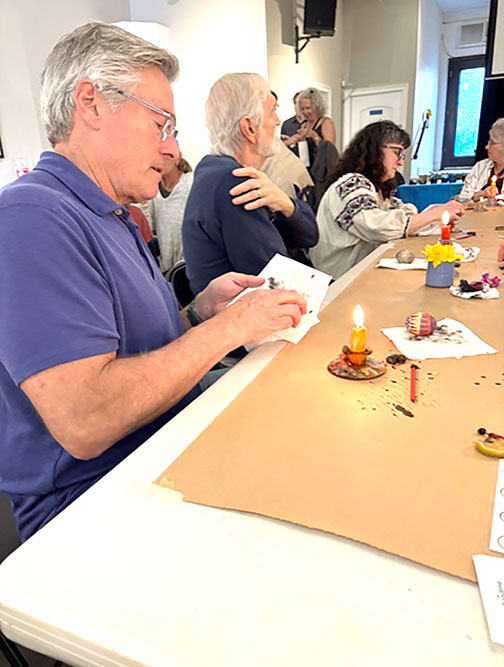
Symbols are drawn on the egg using a wax-resist method that employs a hot wax pen called a “kistka,” which has a brass tip and a well to hold a small amount of wax. The wax is melted by candle flame and used to draw the symbols on the egg.
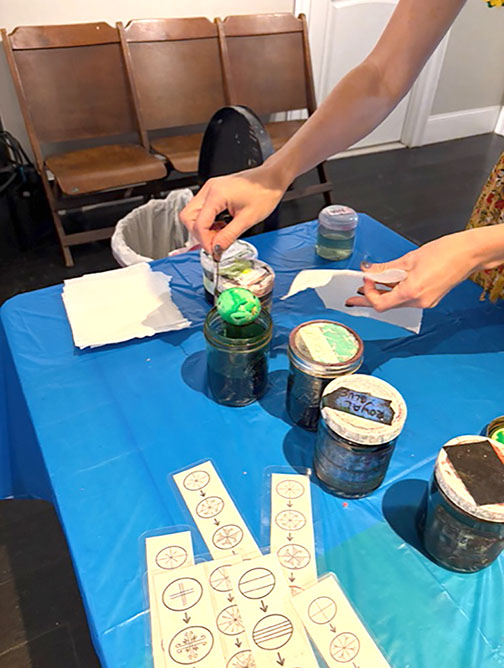
After each wax application, the egg is submerged in dyes that may range from pastels to deep blues, greens and black. The portions of the egg that are covered in wax resist the dye. When the wax is melted and wiped off, the design reveals itself.
Though patience is necessary, the ability to create a beautiful egg is something just about anyone can do – and the more you do it, the better you get.
“It’s not about being perfect. It’s about sharing,” Santa Maria said. “I make about 50 eggs each year and I give them all away.”
Healing – and Defiance
The Pysanky for Healing workshop was organized by Ukrainian-American artist and textile designer Natasha Halbout and her husband David Halbout, owner of French Fix, a furniture design firm, for whom this celebration of Ukrainian folk art holds special significance. For the past two years, the Halbouts have been engaged in a grassroots effort to deliver medical supplies, adaptive clothing and small comforts like books and candy to wounded soldiers now recovering in hospitals across Ukraine.
Sharing the art of Pysanky is “a quiet act of defiance in the midst of destruction,” Natasha said.
A portion of the proceeds from the Pysanky workshop were dedicated to their efforts to ease the suffering of the wounded soldiers in Ukraine.
An Ancient Craft
The creation of Pysanky has been associated with hope and healing for thousands of years, Santa Maria told the group. People were pursuing the craft long before the pyramids were built, she continued. It is a folk art credited to the Trypillians; a sun-worshipping culture indigenous to the land that is now Ukraine.
When Christianity was introduced to Ukraine in the 10th century, the traditional symbols drawn on Pysanky took on Christian significance as well.
To write a Pysanka is to conjure peace, notes Santa Maria, to inspire hope, to make something beautiful with the full intention of giving it away.
“The tradition is, you share it,” she said. “It’s not about being perfect, it’s about sharing. Bringing peace into the world, that is the tradition.”
Santa Maria, who teaches the art of Pysanky seven days a week this time of year, had a fairy-tale-like introduction to the practice.
“You’re wondering what the hell this Italian girl is doing teaching Ukrainian art,” she laughed.
At the age of 19, she took a part-time babysitting job to help her through college. She hadn’t been working long when she began to wonder what the woman who had hired her was up to.
“She’d leave (my) money on the counter and disappear, but her car never left the driveway,” Santa Maria recalled.
Driven to investigate the mystery, one day she bravely opened the basement door.
“What I saw there changed my life,” she said.
There was her employer, huddled over a candle flame in the otherwise dark cellar, “with a bowl of what I thought were painted rocks.”
Was she a witch? Was she crazy? It was a mystery Nancy Drew never encountered, for sure. To Santa Maria’s good fortune, the fairy-tale ended happily ever after. The woman welcomed her interest, explaining exactly what she was up to with an offer to teach her how to do it. “I always wanted to teach a daughter,” the woman told her.
“It is one of the very few (art) forms on earth passed on through the matrilineal line,” Santa Maria said.
Soon she, too, was working by candlelight, turning out the first of many hundreds of eggs she has created in the years since.
‘Backyard’ Eggs
Today, when eggs are easily available year-round (at least prior to avian flu), it’s enlightening to remember that, left to the ancient ways of nature, chickens don’t lay eggs year-round. Commercially produced eggs come from chickens exposed to artificial light, increasing their egg production.
Mother Nature’s timetable is different. Hens don’t lay eggs in the winter. It’s only in early spring, as the days of light grow longer, that chickens begin laying eggs again.
In pre-modern times, Santa Maria said, “If you got an egg, it meant that spring is finally here.”
Santa Maria raises her own chickens and uses wax from her own beehives to make Pysanky. She recommends using raw, room-temperature eggs from “backyard” chickens instead of supermarket eggs because the quality of the shells is better.
Secrecy and Refuge
During times of strife and religious oppression, the writing of Pysanky retreated into secrecy, the darkened rooms in which they were created serving as a refuge from the scrutiny of unfriendly eyes.
In 1941, in an attempt to destroy Ukrainian culture and spiritual practice, Soviet dictator Joseph Stalin outlawed the creation of Pysanky. Nevertheless, the tradition endured, carried on in secret in Ukraine at risk of death, and across the peaceful world by the Ukrainian diaspora. Even in the midst of war, the tradition continues.
One woman taking the workshop said she had recently spoken to her relatives in Ukraine, who told her they were preparing to get together Holy Thursday to make the Pysanky they will give away on Easter.
Legends of Pysanky
There are many legends associated with Pysanky, Santa Maria said.
One is that on a beautiful fall day, all the singing birds fell out of the sky. The people picked them up and took care of them through the winter. When the birds were released, they returned to thank their benefactors by laying beautifully decorated eggs.
Another belief is that there is a monster chained to a cliff in the mountains of Ukraine and it is the embodiment of evil, Santa Maria said. When the monster is chained, peace and harmony blanket the Earth. But when the chains grow loose, war, suffering and confusion erupt.
“I am writing Pysanky as I always have to keep this monster chained,” Santa Maria said.
“These are considered weapons of peace.”
The article originally appeared in the April 10 – 16, 2025 print edition of The Two River Times.