Sunayana Prabhu
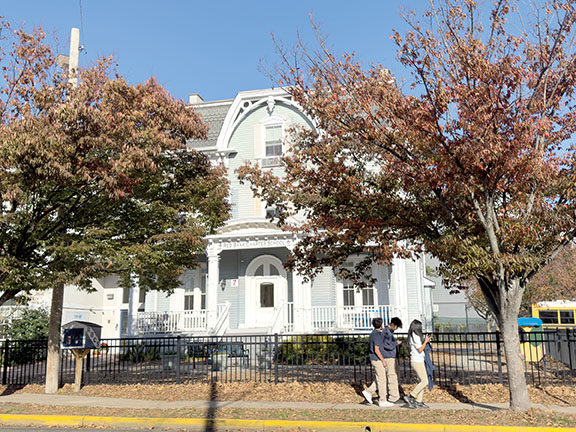
RED BANK – The Red Bank Board of Education (BOE) is urging the state to deny the Red Bank Charter School’s renewal application, effectively calling for the closure of the pre-K through eighth-grade school. The BOE is advocating for a unified public school system, which they say would reduce financial strain on the district.
It also claims the charter school enrollment reflects racial segregation.
The BOE launched an online petition to close the school, which had 832 signatures as of Nov. 10. The board also passed a resolution Sept. 15 opposing the charter school renewal and sent a letter to the state opposing renewal of the charter school’s application.
Some BOE members appeared at the Oct. 8 borough council meeting and asked the council to back its appeal.
Patrick Dorsey, a charter school trustee who was at the meeting, called the BOE’s petition to close the school “divisive.”
Kristen Martello, the head of Red Bank Charter School (RBCS), did not respond to requests for comment on the issues raised by the school board this year.
The charter school debate arises every five years at the end of the charter’s term. Its present five-year term expires in 2027. The New Jersey Commissioner of Education, Lily Laux, will make a final decision on the renewal by February 2027.
Over the years, RBCS has drawn criticism, with some in the community concerned it creates racial and socioeconomic disparities and affects district funding. The school has been operating for 30 years.
According to the BOE’s petition, directed to Laux, the charter school’s enrollment demand has declined. At the same time, maintaining separate school systems has created duplicative costs. The petition argues that unifying the school district could reduce administrative expenses and make programs and services, including sports, arts, bilingual support and student services, available to all Red Bank students.
Anne Roseman, vice president of the BOE, asked the council to pass a resolution supporting the board’s position. She said the two systems together serve fewer than 1,300 students. Roseman noted that 146 Red Bank students attended the charter school last school year; it has a capacity of 195.
“The Red Bank Public Schools are required to transfer approximately $2.9 million annually to the RBCS, out of which it is estimated that $2 million covers duplicative expenses,” Roseman told council members.
Roseman also argued that having two public school systems “perpetuates enrollment disparities in economically disadvantaged students, multilingual learners and students with complex special education needs.” She said borough schools could accommodate students currently attending the charter school.
Two other residents asked the council to put the issue on a future agenda. Resident Julie Lazat noted a rise in property taxes. “In a town as small as Red Bank, I believe it is reasonable for the council to consider whether maintaining separate, autonomous public school systems is the most effective use of our community’s resources,” Lazat said.
Dorsey, the charter school trustee, defended the school’s record and its place in the community. “For 28 years, we’ve educated children, provided families with an additional public choice, partnered with organizations throughout our community, and remain committed to the academic achievement, character education, accountability and service,” Dorsey said. He added that the state DOE conducts a comprehensive review of the school every five years. He said the charter school intends to continue serving students and families.
Mayor Billy Portman said the BOE was “a little misdirected because ultimately this is not the borough council’s decision to make.” He noted that the council’s 2021 unanimous resolution advocating for the charter school’s closure remains in effect and encouraged residents to direct advocacy toward state officials. “The reality of it is, the state likes charter schools,” Portman said. “I don’t think that they’re suddenly saying, ‘Oh, the mayor in Red Bank doesn’t like the charter school. We’re going to close the charter school.’ I really think that that’s where the effort should be placed.”
Council member Ben Forest said he planned to investigate the council’s influence in the renewal process, including consulting the superintendent and other relevant parties, before weighing in. “I don’t dislike the charter school, so it’s something I’m wrestling with a little bit,” he said. Council member Laura Jannone pointed to a state committee formed by Sen. Vin Gopal (D-11) to examine charter schools and said residents could also contact state lawmakers.
The council took no new vote on the charter school issue during the meeting.
Red Bank Public Schools Superintendent Jared Rumage, Ed.D., has raised the possibility of closing RBCS since 2015, a year after he was appointed superintendent, saying he believes the two-district system has contributed to segregation in Red Bank.
Charter schools are established through applications approved by the state education commissioner. An initial charter may be granted for four years, with renewals generally considered at five-year intervals. According to the DOE, renewal gives schools an opportunity to demonstrate academic, fiscal and organizational viability and assess progress toward their goals.
As part of its review, the state conducts a school site visit and interviews with trustees, administrators and teachers. The commissioner also evaluates state assessment results, annual and financial reports, monitoring reports, public comments and other evidence before deciding whether to renew a charter.
In a letter to the borough council in 2021, Martello, the head of RBCS, opposed Rumage’s claims of segregation and said the charter school’s student population directly reflects the racial and ethnic breakdown of families in Red Bank.
According to the most recent data from the National Center for Education Statistics, the DOE’s 2025-26 fall enrollment shows 182 students enrolled in the charter school: 120 are Hispanic, nine Black, 47 white, three Asian and three who identify as more than one race.
That is a change from the data released in Martello’s letter five years ago, which said 53% of RBCS students are Latino, 7% are Black, 40% are White, and 1% are Asian. “These demographics directly mirror the U.S. Census Bureau’s American Community Survey results, which show that Red Bank’s overall school-age population in grades K-8 is 54% Latino, 6% Black, and 40% White.”
She further wrote that any student who comes from a low-income background gets a “weighted preference to get into our school which is based on a random lottery system. We are a public school and there are no tests or admissions criteria to attend Red Bank Charter School.”
She also said that RBCS “is not to blame for tax increases in Red Bank.” After the state’s school funding law was updated in 2018, “Red Bank has seen significant increases in state support for its public schools – both district and charter.” She noted that public charter school students are included in the district enrollment count when the state calculates the state aid to be given to Red Bank.
According to Martello’s letter, the total aid increase for charter schools year over year was $305,000. Red Bank’s total equalization aid increased by $1.3 million year over year. Additionally, the local tax levy was increased by $363,000. Red Bank’s total revenue increase was $1.7 million year over year, while charter payments increased by $305,000 (12.3%) over the same period.
The charter school’s website states that for admission, “residence in Red Bank is not required. RBCS conducts a lottery for admissions. Applications must be submitted by March 17, 2027, to be included in the lottery. The lottery will take place on March 18, 2027. Applications are accepted year-round.”
This article originally appeared in the November 12-18, 2026 print edition of The Two River Times.