By Sunayana Prabhu
RED BANK – Plans to redevelop the borough’s train station area include no more than 400 residential units, 900 parking spaces and 50,000 square feet of retail space, alongside traffic-calming measures, pedestrian-only streets and significant green spaces. The latest designs were unveiled during the second public workshop, Tuesday, Dec. 17, at the Red Bank Senior Center.
The project aims to transform the existing train station into a New Jersey Department of Transportation-approved transit village, emphasizing a “live, work, play” lifestyle. The workshop was hosted by borough officials and included representatives of SK+I Architecture, Denholtz Properties, NJ Transit’s designated official redeveloper of the train station area, and BFJ Planning. Susan Favate, a professional planner from BFJ who updated the borough’s 2023 Master Plan, is also working on the train station redevelopment.
Efforts to designate the train station area as a transit village began in 2018, but plans slowed during the COVID-19 pandemic. In April, the borough council declared 12.94 acres of the train station site as an area in need of redevelopment. Borough officials hosted the first public workshop on the project in the summer, during which they gathered resident feedback that has since been incorporated into updated designs.
SK+I Architecture’s associate principal, Chris Huffer, said construction is expected to begin within three years and be completed by late 2028.
According to the SK+I presentation, the redevelopment focuses on two primary areas around the train station: the north and south sides of the tracks, which are mostly used as commuter parking lots. The plan envisions a mixed-use development and a community gathering hub that bridges the divide between the west and east sides of Red Bank.
North Side Developments
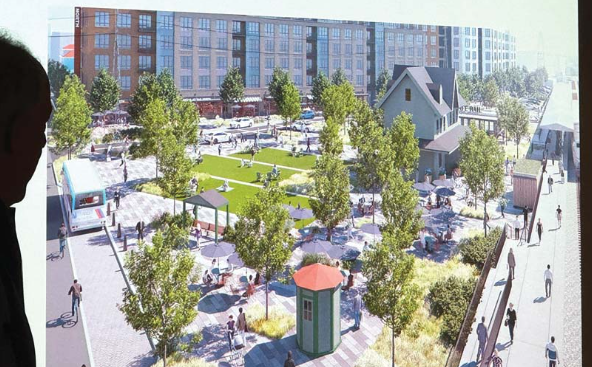
The north side of the train tracks will feature two six-story buildings with ground-floor commercial spaces and residential units above. Parking garages integrated into the buildings will replace existing commuter parking. A “Station Square” adjacent to the historic train station is planned as a central gathering space, with a small “Rail Café” potentially repurposing an old train car to provide amenities for commuters and visitors.
“Station Square becomes an anchor on the west side of Monmouth Street, like Broad Street is an anchor on the east side,” said SK+I’s principal Robert Goodill, noting the design sets the framework of equity and connection between the east and west sides of the borough. The redevelopment of the train station is an exercise in “urban repair,” he said. Landscape architect Tom Baur described the square as a “people-friendly plaza” with paving, trees, shrubs and lawn areas creating a park-like setting. “This can be a tremendous place for Red Bank residents and visitors to enjoy and socialize,” he said.
An “Oakland Street Promenade” will connect the central Station Square area to the surrounding Oakland Street, offering a “curbless environment,” Goodill said, with priority to pedestrians and cyclists. Traffic calming measures will restrict cars to 5 MPH on the “serpentine” street with a “little bit of rumble” that will temper the speed. The street can also be closed for community events such as farmers markets, art fairs or car shows.
South Side Developments
On the south side, a “head and tail” building design is planned. The “head” will be a three-story structure with an urban character and ground-floor retail, while the “tail” will be a five-story residential building set back from the street to transition to nearby neighborhoods. Private residential courtyards will provide amenity spaces for residents.
A proposed street connection between Chestnut Street and East Leonard Street will improve circulation and access. The architecture on the south side will feature smaller windows and setbacks to better integrate with the surrounding residential areas.
Favate confirmed that 20% of the residential units will be designated as affordable housing, helping Red Bank meet its state-mandated affordable housing obligations.
Goodill emphasized the project’s potential to generate significant municipal revenue. Currently, the borough receives no revenue from the NJ Transit property. Additionally, he noted the development is projected to generate over 1,500 construction jobs and dozens of permanent jobs.
While many residents praised the inclusion of green spaces and pedestrian-friendly designs, some expressed concern about the scale and density of the development.
Resident Mary-Ellen Mess argued the plan was “too big and corporate-feeling.”
“This looks like something you’d see on Route 1, not in Red Bank,” said Mess. “It doesn’t say anything about Red Bank to me.”
Other residents echoed concerns about the heights and masses of the buildings, arguing they would dwarf the surrounding neighborhoods. Traffic and access to the train station were also major points of contention. Some suggested relocating or reconfiguring the bus stops on Monmouth Street to improve circulation.
Emily Sullivan, another resident, questioned whether the development would benefit the broader community. “This should be a really walkable and accessible area for people to meet up and not need to buy a coffee or buy a bagel or go shopping or go to an expensive restaurant,” she said. Bauer assured residents that the outdoor spaces would be accessible without requiring purchases. Resident Marianne Donahue suggested partnerships with existing local businesses to ensure their inclusion in the redevelopment. Concerns about parking for the historic Armory building were also raised. Favate confirmed an agreement with NJ Transit to provide parking, though details are still being finalized.
Resident Stephen Hecht questioned the access to supportive services for future residents, such as school, medical care and professional services. “We need some supportive services, and I haven’t heard a word about that,” Hecht said. “Any chance that the developer might be interested in providing a building for the school?”
“I think we could allow that as a permitted use within the ground floor space, if there was somebody that wanted to come and take space as a school. Absolutely open to that,” said Steve Lidster, a representative from Denholtz.
Deputy Mayor Kate Triggiano defended the borough’s pursuit of a transit village designation, which would unlock state funding and incentives. She said the redevelopment aligns with the community’s vision for smart growth as outlined in the updated 2023 Master Plan. The redevelopment area was identified as a key link between Shrewsbury Avenue and the Central Business District.
The draft redevelopment plan is expected to be finalized by February, with further public hearings and opportunities for input before approval.
The article originally appeared in the January 2 – 8, 2025 print edition of The Two River Times.