SEA BRIGHT – The governing body is planning to meet the state-mandated affordable housing obligation within the borough.
At Tuesday night’s meeting, the Sea Bright Borough Council passed an ordinance to amend and supplement Sea Bright’s land use code to establish regulations and a mandatory affordable housing set-aside in connection with future residential development projects in the borough.
A second ordinance was also passed to establish affordable housing development fees in the borough. The ordinance allows municipalities under the jurisdiction of the Council on Affordable Housing (COAH), with a court-approved affordable housing spending plan, to organize an affordable housing trust fund.
The development fees can be attached to non-residential development projects and used to complement federal, state and local monies to increase and maintain the borough’s supply of safe and sanitary affordable housing units.
Mark A. Leckstein, borough council president, and Mayor Dina Long said establishing these ordinances will allow Sea Bright to start formulating a suitable affordable housing plan.
“It’s mandated by the state. We have to do this,” Leckstein said. “We don’t have a plan at this time, but now we can move forward with planning to fulfill our obligation.”
New Jersey is currently in its third round of Fair Share Housing Obligation, a cycle that began in 1999 and is due to end in 2025, when fourth round guidelines and obligations will be established.
According to data published in 2015 by the Fair Share Housing Center, in the previous round (1987 to 1999) Sea Bright’s initial obligation was set at 37 affordable units. The borough’s capped present need is 11 units, and its capped prospective need is 12 units.
The totals put the borough’s unmet need at 60 affordable units.
The governing body mandated that all new multi-family residential developments of five or more units will be required to provide an affordable housing set-aside as follows:
• A minimum of 20 percent of the number of for-sale housing units proposed in a development application must be designated as affordable units.
• A minimum of 15 percent of the number of for-rent units proposed in a development application must be affordable units.
These proposed affordable units can be offered on-site or off-site as long as they are provided within the borough.

Photo by Chris Rotolo
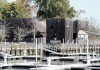
These newly established guidelines will impact all future developments in Sea Bright, including a proposed multimillion dollar riverfront housing project that was introduced this past December at a special meeting. That project proposes 44 new housing units, including a 20 percent affordable housing set-aside, and could bring with it more than 40,000 square feet of public green space on the bank of the Shrewsbury River.
Establishing an affordable housing plan will also protect the borough from builder’s remedy lawsuits. Towns that do not have court-approved affordable housing plans are susceptible to lawsuits from developers who can propose affordable housing developments in any section of a municipality. Establishing an affordable housing plan can allow the borough to dictate affordable housing zoning overlays in the town.
A previous builder’s remedy lawsuit levied against the borough was settled in March 2011, when municipal officials reached an agreement with the owner of Gaiters, a former restaurant at the foot of the Route 36 Highlands Bridge. The borough council memorialized an ordinance to create a new affordable housing zone on the site.
The proposed project on the Gaiters site was delayed by Super Storm Sandy, which made landfall in October 2012. Work has yet to begin on the proposed project. Councilman Charles H. Rooney said developers have obtained all necessary approvals.