By Emily Schopfer
SEA BRIGHT – Sea Bright faced many hurdles in recent months: beach erosion, a contested municipal election and frequent riverside flooding. With $37 million in beach replenishment secured and the election wrapping up, the borough can turn its attention to the Shrewsbury River.
The river has caused significant flooding in recent months, most recently during the late-September nor’easter, which brought over five feet of water to some parts of the borough’s downtown section.
To address repeated flooding, the borough council proposed the Flood Mitigation Project this summer. It would include new check valves, pump stations and roughly 1,350 feet of improved riverfront bulkhead between North Beach, Downtown and South Beach. Much, if not all, of the project area already has a riverfront bulkhead, but existing bulkhead is below the 7-foot height requirement.
The council first proposed the project July 21, when it introduced a $2.5 million bond ordinance. For more on the borough’s Flood Mitigation Project, see the Nov. 3 “Public Response to Bulkhead Plan Floods Sea Bright,” article on the Two River Times website.
The public was divided on the project, with some arguing during a lengthy Aug. 18 public hearing that it is necessary for the town’s benefit and others questioning the ethics and legality of using a municipal bond to fund it. Nonetheless, the borough secured all 11 necessary easement agreements for private properties along the improved bulkhead path, and the bond ordinance was approved in a four-to-one vote Sept. 15.
Even with council approval and secured easement agreements, an unexpected roadblock halted project progress. Council member Marc A. Leckstein filed a lawsuit Oct. 2 against fellow council member Jeffery Booker and the borough, citing potential bias in Booker’s Sept. 15 vote and the constitutionality of public funds being used on private property. For more on the lawsuit, see the Oct. 22, 2026, Two River Times coverage.
While unable to comment directly on the lawsuit, council member Erwin Bieber sat down with The Two River Times to talk about where the Flood Mitigation Project stands. Bieber is a member of Sea Bright’s Beach Committee, chair of Sea Bright’s Flood Mitigation Committee, and delivered the presentation to the public Aug. 18. Bieber did comment on the easement agreements, which were signed before the lawsuit was filed, and are separate from the claims in the lawsuit.
“None of the property owners approached the town asking for the bulkhead,” Bieber said, but “after over a year of discussion… they realized there was a greater good and benefit.” If even one of these 11 properties along the proposed project area refused the easement agreement, the project would be dead in its tracks. “It has to be an all or none,” Bieber explained, because if there is any gap in the bulkhead, floodwater will still be able to get through and will disproportionately impact that property.
Project Funding
The Oct. 2 lawsuit focuses on the bond ordinance, which Bieber assured was not Sea Bright’s first or only plan to fund the project. After 2012’s Super Storm Sandy, the U.S. Army Corps of Engineers analyzed the potential project, Bieber said, but they wanted to make two massive changes. The first was to make the bulkhead 9 feet above high tide rather than 7, and the second was requiring public access to the waterfront regardless of private property because the project would be publicly funded. “While their design was good,” Bieber said, the resulting demands “were not acceptable.”
The project sat dormant for a number of years. When Bieber joined the council five years ago, he said he “rang every doorbell, 1,400 doorbells,” asking about top concerns for residents. “Flood mitigation came to the top.”
After the U.S. Army Corps of Engineers proposal was rejected and “federal funding went nowhere,” Bieber said the borough also went to the Federal Emergency Management Agency (FEMA), the New Jersey Department of Environmental Protection (NJDEP) and even the state Department of Transportation (NJDOT), under the argument that Ocean Avenue (Route 36) is a state highway prone to flooding. Bieber said he connected with Christopher Feinthel, NJDOT’s assistant commissioner of operations, who told him the project was technically sound and did not have too high a price tag given the potential benefit. However, due to internal decision-making, NJDOT eventually pulled funding.
Impact on Borough
Sea Bright eventually decided to fund the project through its own bond ordinance, Bieber said. “Even with this project, the tax rate is going to go down,” he said. The borough has expiring debt that will reduce annual property taxes by about $120,000 per year. The bulkhead, he said, will only add about $110,000 per year. “Expiring debt actually exceeds the debt from the bulkhead,” he said.
The $2.5 million price tag is the highest estimate, Bieber explained during his Aug. 18 presentation. Based on the average residential property tax of $10,160 in 2026, a $2.5 million project could cost Sea Bright property owners about $109 per year, or $9 a month. Avakian Engineering, the consulting and municipal engineering firm behind the project, estimates the total to be closer to $1.75 million, which would result in an $85 per year increase or $7 per month.
The borough is also set to receive a projected $600,000 to $800,000 a year in new property-tax revenue from the new The Haven at Sea Bright luxury riverfront redevelopment, Bieber said. The asking prices for The Haven’s 44 units are expected to start just under $2 million, almost 78% higher than the average home value of $1.08 million in Sea Bright, according to Zillow.
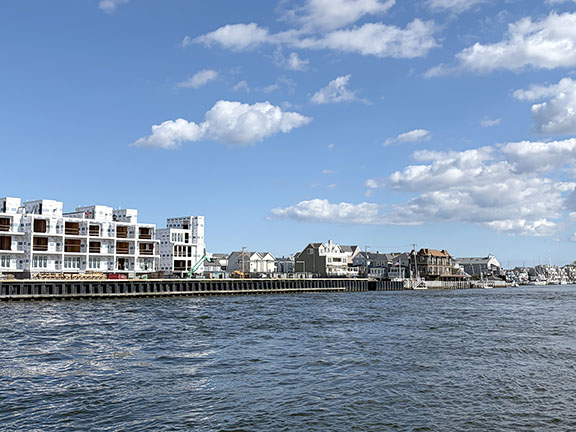
The Haven also provided 840 linear feet of new 7-foot-tall steel bulkhead along the riverfront between River Street and Beach Street.
“Most of the project (is) paid for by somebody else,” Bieber said, adding that in addition to the portion of bulkhead paid for by The Haven, check valves will be partially funded by NJDOT and three out of four pump stations downtown are already built.
In addition to The Haven, portions of the bulkhead have already been replaced by previous borough projects, work by Jersey Central Power & Light (JCP&L), private property owners, and during the Rumson-Sea Bright Bridge construction.
The remaining 1,350 feet of the total 2,800-foot-long bulkhead funded by the bond would also not be a long-term maintenance cost to the borough. After a one-year builder’s warranty, homeowners would be responsible for maintaining the bulkhead. When asked what grounds Sea Bright has to enforce this, Bieber referred to Ordinance 9-2020, which states that if 50% of a property owner’s bulkhead is not in good condition, they must repair it.
The problem is not deteriorating bulkheads, he said; it is bulkheads that are too low. The project area already has riverfront bulkhead; this project would be replacing the existing bulkhead to bring it up to borough code that states new bulkheads must reach a minimum elevation of 7 feet. Violations can result in a fine of up to $2,000 and 90 days in jail.
The project is bigger than protecting one home: “It will protect hundreds of homes in the downtown… protect businesses and first responders,” Bieber said. “This problem (flooding) is here to stay,” and it is a “devastating problem that has a very practical solution.”
Moving Forward
As a result of the lawsuit, the project may undergo a special election or municipal referendum in which residents would vote directly for or against the ordinance, Bieber said. This would not be the first time this happened in Sea Bright. In June 2016, Sea Bright Borough Council and former Mayor Dina Long approved three bond ordinances totaling $12.9 million for new municipal, beach and community facilities. In September of that year, residents overwhelmingly voted in favor of the bond, by a two-to-one margin.
Regarding the current bond ordinance, Bieber said that while many residents at the Aug. 18 hearing favored it, it would be hard to predict how residents would vote if given the opportunity. It’s “hard to tell until it goes to a ballot,” he said.
To hold a referendum, a petition signed by at least 15% of legal voters in the borough must be filed with the borough clerk. The ordinance is suspended from taking effect in the meantime. A vote would then be held at the next general or regular municipal election; or, if no such election is to be held within 90 days, the council shall provide for a special election, according to New Jersey State Law.
Early 2027 is when the “project can probably proceed,” Bieber said, but it still must undergo final design phases, go out for competitive bid, and have proper NJDEP permitting. The earliest Bieber foresees groundbreaking is fall 2027, which is “sensitively close” to the 2028 easement agreement expirations, and “we are concerned,” he said. For the project to proceed within its deadline, a “lot of dominoes have to fall in a certain way.”
The results of the Nov. 3 election may also have implications on both the ongoing lawsuit and Flood Mitigation Project. Leckstein, plaintiff in the Oct. 2 lawsuit, was successfully reelected to council. Sea Bright saw a full Democratic sweep, with Leckstein and Susan Markson both being elected to fill the open full-term seats, and Margaret C. Fisher being elected to fill the unexpired term. Sea Bright Borough Council was a mix of Republican, Democratic and Independent members, but as a result of the Nov. 3 election, it is now 50% Democratic.
The single unexpired term was temporarily filled by Republican Jeffery Booker, who was appointed Sept. 15. He will remain in this seat until Dec. 31. Booker was also named as a defendant in the lawsuit.
This article originally appeared in the November 12-18, 2026 print edition of The Two River Times.