By Laura D.C. Kolnoski
FORT MONMOUTH – In response to concerns regarding ongoing demolition on Fort Monmouth, The Two River Times reached out to officials involved.
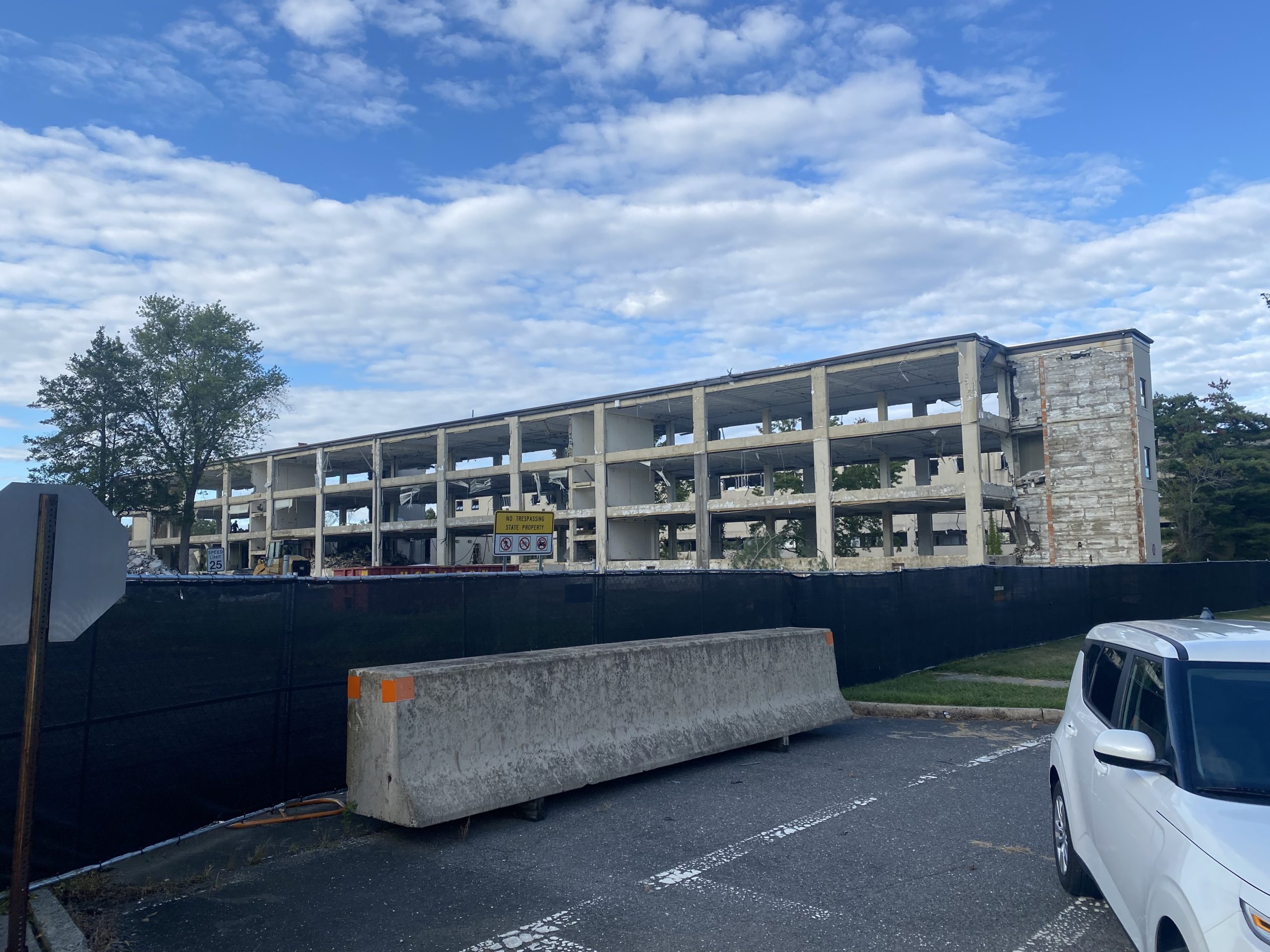
Close to 90 structures on the former U.S. Army base are meeting the wrecking ball to make way for Netflix Studios Fort Monmouth. Additional demolition and construction sites are active in all three towns the fort spans. Among the highest-profile are the mixed-use RiverWalk Center in Oceanport, the residential Liberty Pointe by Lennar at the old Howard Common site in Eatontown, and the Robert Wood Johnson Barnabas Health/Monmouth Medical Center complex in Tinton Falls. State and local rules must be adhered to, with monitoring ongoing throughout, local officials said.
“We take the health and safety of our community very seriously, and I’m happy to provide clarity on the rigorous processes in place for any development at the former Fort Monmouth site,” said Oceanport Mayor Tom Tvrdik.
The Netflix complex will cover 292 of the fort’s total 1,126 acres and will be built in Eatontown and Oceanport only. As of press time, demolition is underway in Eatontown and is expected to begin in Oceanport shortly. Of the studio’s 12 soundstages, eight will be in Eatontown and four in Oceanport.
“Netflix has not yet applied for or been issued a Uniform Construction Code demolition permit from the borough for this phase of the project,” Tvrdik said in late September, adding the streaming company has applied solely for initial zoning approvals to begin the demolition permitting process. “The process is thorough and multi-stepped, and we are still in the early stages.” Preliminary activity in Oceanport is a precursor to Netflix applying for initial zoning approvals, Tvrdik clarified.
Netflix has not yet closed on the “Mega Parcel” but obtained special permission from the Fort Monmouth Economic Revitalization Authority (FMERA) to perform abatement and demolition work, removing over a million square feet of blight. According to FMERA officials, abatements, which occur inside a building, are the responsibility of the developer and must be reported to the boroughs, which must sign off. When demolition is occurring, the building has already been cleaned.
The contract between Netflix and FMERA is expected to be signed by the end of the year. Netflix hopes to open the first phase of its new studios in 2027, with Phase 2 coming online in 2028. Tvrdik said Netflix aims to conclude all demolition by May 2026.
Following New Jersey Department of Environmental Protection (DEP) Perimeter Air Monitoring Technical Guidance established in 2023, Netflix is conducting continuous air monitoring, officials said. Aeroqual® Dust Sentry units provide real-time measurements of air conditions to defined limits and provide alerts to construction management and air monitoring teams.
“Netflix is performing this as a best management practice to be a good neighbor,” a source close to Netflix told The Two River Times. “The safety of everyone on our construction sites and in the surrounding community is our top priority. We remain fully committed to adhering to all applicable state, county and borough regulations throughout the development of our studio project.”
As Tvrdik explained, the applicant must first obtain zoning approval, then obtain a Uniform Construction Code Demolition Permit. The developer then submits a comprehensive application for a demolition permit, “a crucial step” requiring documents including a copy of the final approval from the state confirming that any required asbestos abatement has been completed by a licensed professional, and a detailed site safety plan including a dust mitigation plan to protect neighboring properties.
“Only after our construction official has reviewed and approved this entire package is a demolition permit issued,” Tvrdik said. Items on Oceanport’s building demolition checklist include a survey of the property showing all structures, notification to adjoining property owners, a plan to safeguard adjoining properties or public rights of way, a soil conservation approval or exception letter, and disconnect letters from utility providers.
“The developer must provide all dump receipts documenting where the debris was properly disposed of,” he said. Debris must be transported to state-licensed landfills and verified with receipts. Once the site passes a final inspection and receipts are verified, a Certificate of Approval is issued, officially closing out the permit.
Regarding air quality and dust control, Tvrdik said “standard and required practice involves actively wetting down debris and using large water misters to prevent dust from becoming airborne. This is exactly what contractors are doing at the portions of the site in Eatontown. When demolition begins in Oceanport, you can expect to see similar robust measures.”
Tvrdik explained that specialized vacuum-style systems are used during interior asbestos abatement to prevent fibers from leaving the building, a process handled and permitted directly by the state. “Once proper abatement and demolition procedures are followed, there should be nothing going into the air besides controlled dust and exhaust from machinery,” he said.
“The DEP has its own separate and parallel permitting process for many aspects of a project this size,” Tvrdik noted. “The developer’s professionals work directly with the DEP, which conducts its own inspections. The borough will receive copies of DEP permits and letters of approval as a prerequisite before we can issue many of our own building permits down the line.”
“In short, there is a layered system of checks and balances between the developer, the state, and the borough,” the mayor said. “No major demolition will proceed until we are satisfied that all safety and environmental prerequisites have been met. We are committed to ensuring this project proceeds safely and with full transparency.”
“The process is generally the same between both towns,” said Eatontown Mayor Anthony Talerico Jr. “This work is highly regulated by the state via the Uniform Construction Code and the DEP. As for the environmental matters, the DEP regulates a large aspect of the process, and their approvals would be considered necessary ‘prior approvals’ for the project to move along.”
The article originally appeared in the October 2 – October 8, 2025 print edition of The Two River Times.