By Sunayana Prabhu
Childbirth is an intense physiological process and many giving birth have had positive experiences in the hands of a trusted doula. That role has long tbeen perceived as support outside the medical care team in hospitals and birthing centers, but not anymore.
A new doula access bill designed to instill more respect for the profession, reduce birthing anxieties and combat maternal and infant mortality was signed into law by Gov. Phil Murphy last month.
The legislation potentially transforming doula care in New Jersey requires hospitals and birthing centers modify protocols that previously restricted doula access and establish policies to ensure everyone has the right to a birth coach, if wanted.
“No hospital in New Jersey can have a policy in place that says doulas aren’t allowed,” said Mary Sefchek, founder of Philomena Birth, a childbirth education center and doula agency in Red Bank. The law is a “huge deal” for doulas in New Jersey, she said.
What is a Doula?
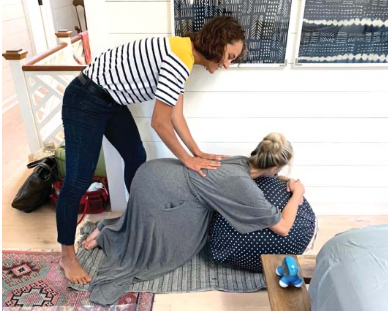
Traditionally, the role of a doula is to inform and educate families on the physiological and medical processes of pregnancy and childbirth. They provide comfort methods to ease anxiety and partner support and help guide parents as they are given choices for care during labor and delivery. A doula works to eliminate “as much fear as possible,” Sefchek said, about what normal, healthy labor looks like, how to manage it through natural coping techniques, communicate with the doctors and nurses, weigh risks and benefits and make informed medical decisions.
“Doulas are not health care workers, but they’re part of the health care team,” said Robert Graebe, M.D., chair and director of the OB-GYN program at Monmouth Medical Center (MMC), a Robert Wood Johnson Barnabas Health (RWJBH) facility. “They’re not nurses, they’re not physicians, they’re not midwives with licensed medical (certification)” but, he said, they are “educated in what the expectation is or what the processes are for patients.”
MMC has had “very good experiences with doulas,” Graebe said, and the new law “would help to codify the training, the responsibilities of the doulas.”
A Part of The Team
To be “welcomed and integrated into the care of mom and labor,” Sefchek said, “normalizes” doula support through childbirth “in a big way.”
Sefchek noted that often “it was hard (for patients) to get accurate information” from hospital staff about doulas. However, under the new bill, hospitals and birthing centers must develop and maintain policies that allow doulas to accompany patients before, during and after labor and childbirth. These facilities will also be required to publicly post their policies and designate a contact to maintain communications between their staff, the doula community and patients.
Considering the maternal health crisis in the country and particularly in New Jersey, Sefchek said, doulas can be “a huge part of this solution.”
Michele Eisenhauer, a registered nurse at MMC, said she is “very proud” of the outcomes from the hospital’s maternity unit which sees “over 500 deliveries a month.” “We are a very busy unit,” Eisenhauer said, highlighting the importance of doulas in providing “a little bit more support sometimes than we can because they’re… able to stay at the bedside longer” when nurses have to attend to multiple patients. And of course, Eisenhauer noted, the nurses are there if the doula has to leave, making it a very cooperative relationship.
Eisenhauer said doulas also help the medical staff after delivery by assisting mothers to “bridge the difficulties with breastfeeding, with skin-to-skin and any issues that they might have.”
A major component of the bill Sefchek is particularly excited about is the posting of doula policies in writing. According to Sefchek, this will change the perception of doulas as outsiders to an integral part of patient support.
She said navigating different hospital floors to support clients was challenging when each hospital, including those in the Two River area, particularly during the COVID-19 pandemic, “created its own policy” regarding where and when doulas were allowed, often requiring them to be on a pre-approved list or have certification from approved agencies before a client’s due date. “If you weren’t on that list, you weren’t allowed on the floor,” Sefchek said, limiting who the patient could choose as a doula.
Getting Paid and Trained
Graebe also noted the new law helps parents afford a doula and makes sure the professionals are getting paid for their work.
The 2020 state budget included $1 million to implement doula coverage through NJ FamilyCare, New Jersey’s Medicaid program. Medicaid officially began to cover doula care in 2021, making New Jersey the third state in the nation to expand this coverage and the first one to require community doulas to be trained in order to qualify for Medicaid reimbursement.
The 2023 state budget appropriated $15 million to increase Medicaid reimbursement rates for perinatal, midwifery and community doula care. According to a release from the governor’s office, the increase provided community doulas a maximum $1,165 reimbursement for labor support and eight additional perinatal visits, up from $900.
In addition to increased payments for doulas, the Fiscal Year 2024 budget also included funding to continue the training of community doulas throughout New Jersey. Since 2018, the continued effort of first lady Tammy Murphy’s Nurture NJ Maternal and Infant Health Strategic plan, an undertaking dedicated to improving Black infant and maternal health outcomes in New Jersey, and the state Department of Health has resulted in the training of over 250 new doulas in the heart of communities most impacted by high maternal mortality.
The bill addresses two key recommendations within the Nurture NJ plan – to develop a communications plan to promote the benefits of midwifery and community doula models of care and that New Jersey hospitals should institute systemic changes to accommodate doulas and safe birth practices.
Combatting Maternal Mortality
On Nov. 20, 2023, Tammy Murphy held a roundtable discussion at University Hospital in Newark to discuss maternal and infant health progress in New Jersey and announced the introduction of this bill in the Assembly. The bill unanimously passed both houses Jan. 8, 2024, before reaching the governor’s desk.
“Evidence shows that doulas help reduce birth complications, lower rates of C-sections, improve mental health, and provide overall essential support and advocacy during the birthing process, making them an indispensable part of a mother’s health care team,” the first lady said in a Jan. 16 press release. The bill, “which ensures doulas are afforded the respect they deserve as a critical care team member with access to birthing hospitals and centers, prioritizes the health of New Jersey’s mothers and is another significant step toward our goal of becoming the safest and most equitable state in the nation to deliver and raise a baby.”
“We are not a birth literate culture” in the United States, Sefchek said. Women turn to the internet for answers they aren’t getting in their doctor’s office. During their doctor’s appointments, “they’re told nothing,” she said. Mothers-to-be “listen to baby’s heartbeat. They pee in a cup. And that’s that. I think they feel the gap in information and the support and they want better care. And that’s where, really, the change is going to come.”
According to Graebe, maternal mortality is a part of a larger problem.
“You can always judge a society by the quality of the care that it provides women,” Graebe said. “We have to do a better job of that through all aspects of women’s health, not just maternal health,” he said. “But a good place you can start is with maternal health because problems that you identify in pregnancy – diabetes, high blood pressure, obesity – they can contribute six and seven times to a higher level of morbidity, mortality, no matter what your race is.”
MMC is part of a pilot program in New Jersey called TeamBirth, where the physician, nurse in labor and delivery, the doula and the parents can communicate about what care they can expect and make their preferences known. The hospital also has an active midwifery program and has been able to reduce C-section rates from 30% to 14%, said Graebe. The new law “will not affect us as far as lowering our C-section rate, but it will help with morbidity and mortality,” Graebe said.
He also noted that when pregnant people become isolated from their support systems – if they move or through other factors – the result can be “bad outcomes.” He recommends patients “have people from their own communities, people that they know, in their own neighborhoods,” who can help bring them to the doctor and bring them to the hospital to answer questions for them or to advocate for them.
“Lack of communication is one of the biggest reasons that people fail,” said Graebe.
That’s when doulas can really make a difference.
“I really don’t think people realize how much support these women are getting from us before we’re even in the labor room,” Sefchek said.
It’s All About Support
The new legislation is envisioned to strengthen and enhance access to doula care in all 21 counties in the state so women and families can be assured their doula can be part of their birth experience.
“I really see the support as family support,” Sefchek said.
“Having your baby should be the most joyous moment of your life. It should not be a moment of fear, a moment of anxiety.”
The article originally appeared in the February 15 –21, 2024 print edition of The Two River Times.