By Sunayana Prabhu
MIDDLETOWN – A district-commissioned review conducted by Ross Haber & Associates was recently delivered to the district’s Board of Education (BOE).
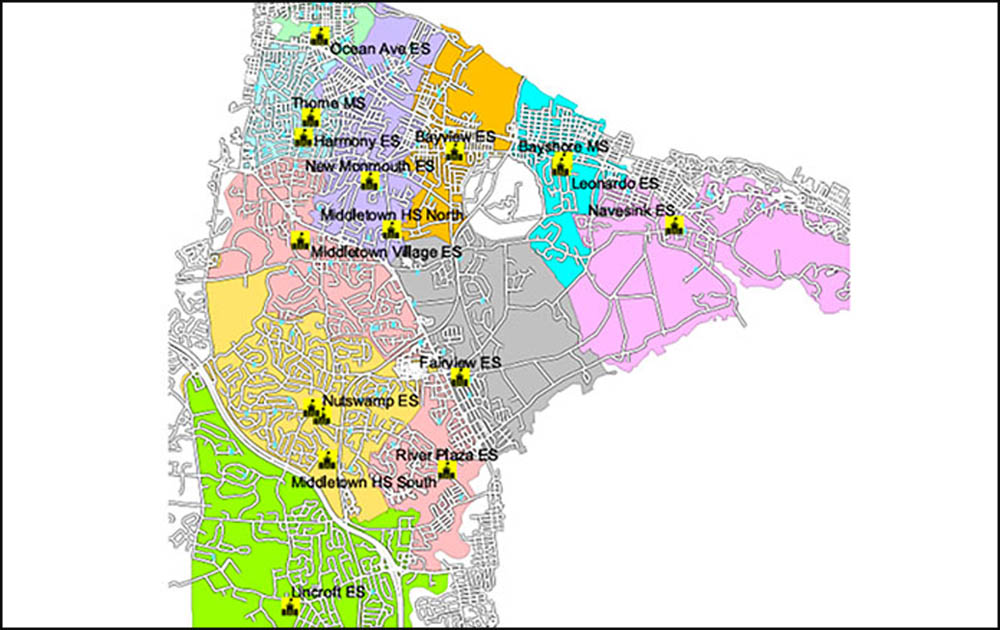
The report proposed a redistricting plan to ease overcrowding in three of the district’s 15 public schools serving students from pre-kindergarten through 12th grade. The plan would reassign 119 students across six schools.
The goal of the study was to evaluate enrollment projections to reduce overcrowding in the future and also to determine efficiency of district facilities – in addition to a boundary study to determine whether school locations are evenly distributed throughout the township.
Founder and president of the firm, Ross Haber, presented results of the study during the Jan. 27 Board of Education meeting.
The Milltown-based firm provides public school districts with services such as demographic studies, enrollment projections, attendance zone analysis and redistricting, facility utilization studies and transportation efficiency studies.
The district currently operates 10 elementary schools, three middle schools, and two high schools – Middletown High School North and Middletown High School South. Under the proposed boundary considerations, Haber presented a redistricting plan and recommended moving a total of 119 elementary students across six schools. Of the two groups of students from Harmony Elementary, 26 students would move to Middletown Village Elementary and another 37 would be sent to Ocean Avenue Elementary. Fifteen Lincroft students would move to River Plaza Elementary and 29 students from River Plaza would move to Middletown Village. Lastly, 12 Nut Swamp students would move to Middletown Village elementary school.
The redistricting plan is meant to better balance class sizes and building usage without closing any of the district’s 11 elementary schools. The plan is also meant to reduce overcrowding at Harmony, Lincroft and River Plaza elementary schools
Last year, the school officials were planning to close Navesink and Leonardo elementary schools, and Bayshore Middle School because of a $10 million budget deficit. But that plan didn’t go through after major public backlash. Six months ago, the BOE commissioned the Haber report to explore a redistricting plan to consolidate its large school district that includes 11 elementary schools, three middle schools and two high schools.
“We’re in a really different position than we were last year financially,” Superintendent Jessica Alfone said at the BOE meeting, noting that the district was “in a budget deficit that we were able to fortunately get some relief from.” Alfone also said that Haber report is only a recommendation, and no decision has been made to implement it.
Haber said the five-year enrollment projections for the school district indicate more students within the district, but overall, he said the anticipated enrollment over the next five years will remain “relatively stable.”
Several residents were disappointed by the report that primarily reviewed elementary schools and left out middle and high schools. Residents said they expected a broader analysis that also directly addressed last year’s controversial talk of closing schools. Many also questioned the impact of moving students away from their friends and what it would mean for their social and emotional stability.
Eric Dowell, a Middletown parent and member of the nonprofit Save Middletown Schools, said the community was “resoundingly disappointed in the report, both in terms of its content and the unexplained, lengthy delay.” He said the report, which was supposed to support the district’s five-year strategic planning process, failed to provide basic information such as school-by-school capacity, enrollment histories and projections, socioeconomic indicators, performance data and budget details.
Instead, Dowell said, the report centered on a narrow redistricting proposal that sought to “nibble around the edges of supposed over and undercrowding in certain elementary schools” by shifting small numbers of students between schools, an approach he said “never had a chance to go anywhere.” He added that some of the data appeared to be incorrect, including a missed count of about 100 students. Dowell noted that multiple BOE members publicly expressed disappointment with the report and said many parents remain eager for a strategic planning process that meaningfully engages affected families.
Board member Jacqueline Tobacco used her Facebook page to comment about the Haber report: “My inbox is overflowing with outrage over the Haber redistricting plan that was presented last week. I hear you all. I was appalled at the nonchalance with which the maps were shown and graphs with individual students being moved out of their home school and away from friends,” she said in the post. She added that the Haber report is “just one piece of data with which the board will have to make decisions on, and I personally apologize to all the families whose children were identified on those slides as being the ones to be redistricted.”
“We always try with the path of least resistance,” Alfone said. “And that’s what this proposal showed a path of least resistance, moving as few students as possible.”
The presentation is one piece of a broader five-year strategic plan that includes various goals from academic to finance intended to build sustainable models for the school district’s excellence.
For now, the district has not announced a timeline for deciding whether to adopt any of the proposed boundary changes or revisit the question of school consolidation.
The Haber report is currently available on the school’s website with a dedicated email address.
Alfone said strategic planning subcommittees were to reconvene with an initial meeting Feb. 18 to incorporate the boundary and capacity findings into a larger district plan.
The article originally appeared in the February 19 – 25, 2026 print edition of The Two River Times.