By Jamie Jablonowski, MPH, BSN, RN, CPH
While the holidays are eagerly anticipated by most, many Americans say their stress increases during this time of year. According to a 2023 survey of 22,061 adults by the American Psychological Association, 89% of U.S. adults say something causes them stress during the holiday season, with the most common reasons being financial worries (58%), gift-giving (40%), missing family or loved ones (38%), and having too much to do (32%). And 1 in 5 adults said “feeling left out or excluded” was a reason for their increased worry.
To combat holiday anxiety, the adults surveyed provided their most common coping mechanisms, including talking with others (41%), managing expectations (38%), reminding themselves that the season will pass (35%) and volunteering to help others (16%). Some adults even said they turn to negative coping mechanisms, like isolation (21%), diet modifications (16%) or substances such as alcohol or nicotine (13%).
While only a small percentage of individuals reported using volunteering to improve their mental health, research shows that giving back can have significant positive outcomes.
The Mental Health Benefits of Giving Back
Stacy Doumas is the Regional Chair of Psychiatry at Hackensack Meridian Jersey Shore University Medical Center. She sees adult, adolescent and pediatric patients at multiple locations, including Riverview Medical Center. She confirmed that science supports volunteering as a way to improve mental health. “Volunteering is the type of giving that’s really shown to lead to lower levels of depression and anxiety,” Doumas said, explaining that volunteering can help lower cortisol, one of the primary stress hormones.
According to Doumas, volunteering creates a powerful shift from worrying about one’s own needs and anxiety to thinking about someone else, which can help create a buffer against stress.
The Science Behind the ‘Helper’s High’
While many people have heard of the “runner’s high,” there is also a scientifically backed “helper’s high” that gives people a good feeling when volunteering their time. Doumas explained that altruism affects the brain’s reward pathway through several different neurotransmitters, including dopamine and oxytocin. Dopamine is associated with pleasure and reward, and oxytocin fosters social connection and a sense of community.
“Not only do you feel good in the moment, but it reinforces that desire to continue helping others in the future,” Doumas said.
“There’s actually something chemically going on in your body that’s making you feel good.”
Combatting Loneliness
Approximately 1 in 3 adults in the United States reports feeling lonely, per the Centers for Disease Control and Prevention (CDC), and about 1 in 4 reports not having social and emotional support. Social isolation and loneliness can increase a person’s risk for health problems, including heart disease and stroke, type 2 diabetes, depression and anxiety, suicidality and self-harm, dementia and earlier death.
Volunteering can provide social support by creating opportunities to build community and a support system in a low-stress environment. “You’re working with others with a sense of meaning and a sense of purpose to help other people, and that fosters connection and bonding,” Doumas said.
“A lot of people are lonely and one of the reasons is isolation from others – not having a support system, not having a sense of connection to either people or community. Volunteering can help them overcome some of that.”
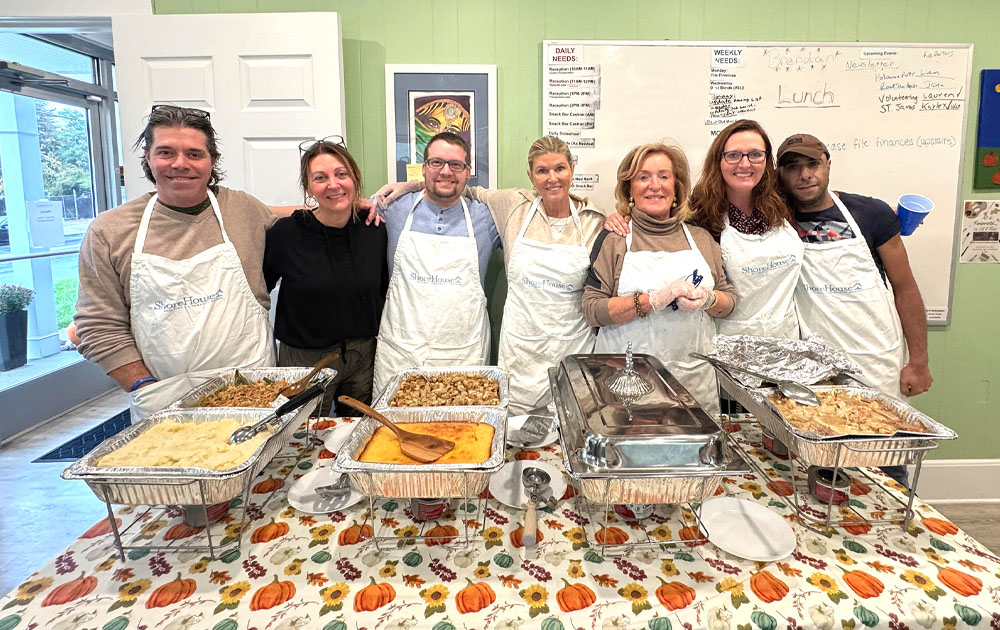
At Shore House in Long Branch, volunteers serve a Thanksgiving meal to the members so no one has to spend the holiday alone. Shore House is open Monday through Friday and serves over 200 individuals. Its mission is to “empower and restore hope, independence and self-worth for people living with a mental illness by providing access to social, education and employment opportunities.”
“At Shore House, our volunteers don’t just give their time – they help build a community where every member can learn, grow and discover their strength,” said Rich Ambrosino, executive director.
Getting Your Family and Children Involved
The CDC noted that young adults and older adults are considered at greater risk for loneliness than other age groups. Doumas highlighted that volunteering could help both create a sense of community and belonging.
For older adults, working with others can create meaning and provide a sense of purpose, which can be transformative if it does not currently exist in their lives. For younger adults who may be more likely to spend increased time looking at screens or working or going to school virtually, Doumas suggested that taking part in community activities can create more opportunities to meet people in person.
If your family values altruism, Doumas said volunteering as a family is a great way to instill this value in your children and to create an opportunity to bond as a family. This can be as simple as participating in a toy drive around the holidays or donating time at a food bank. She said parents can share their personal volunteer activities with their children or explore ways of volunteering that appeal to their child’s particular interests.
Avoiding Burnout: Healthy Boundaries Matter
While volunteering can be beneficial, balance is important. Donating money or time should be tailored to your lifestyle and may look different for everyone. Doing too much can also lead to burnout and exhaustion; it’s important that the effort extended is mutually beneficial.
“You want to make sure that you have healthy boundaries and that you do something that fits in your life in a way that it still feels rewarding and energizing and good for you and not in a way where you’re resentful,” Doumas said.
And giving back doesn’t have to be a formal affair. Doumas emphasized that the holidays can be especially challenging for those who are facing financial insecurity or food insecurity, as well as those who may be mourning the loss of a loved one. It can be incredibly rewarding to support those in your life who may be struggling this time of year simply by providing a listening ear or inviting a neighbor over for a holiday meal. These small acts of kindness could be the spark that changes someone else’s season, maybe even your own.
Local Volunteer Opportunities
• Lunch Break, Red Bank – A nonprofit that offers food, clothing and fellowship to those in need. Currently accepting gifts for gift cards for families; lunchbreak.org.
• Hackensack Meridian Health – HMH is currently accepting donations for teens and tweens, as well as personal items for patients, diapers and food donations. For more information, contact ellen.hahn@hmhn.org.
• Shore House, Long Branch – A local community resource open to adults living with mental illness; shorehousenj.org.
The article originally appeared in the December 4 – 10, 2025 print edition of The Two River Times.