Monmouth County English-Speaking Union hosts students in annual program
By Sophia Wiener
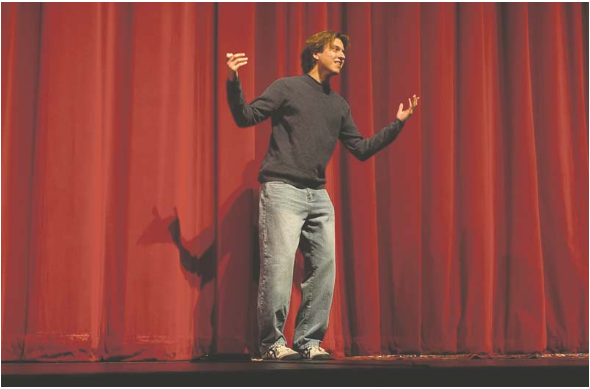
LINCROFT – “No, no, I am as ugly as a bear,” cried Red Bank Catholic senior Sarah Moser last Saturday, spotlighted against a red curtain on the stage of Brookdale Community College’s Performing Arts Center. Moser, from Matawan, was one of five students taking her turn reciting passages from Shakespeare’s works for the Monmouth County English-Speaking Union’s (ESU) annual Shakespeare Competition for High School Students.
Moser’s performance was a monologue from Act 2, Scene 2 of “A Midsummer Night’s Dream,” in which insecure, lovesick young Helena refuses to believe Lysander could love her rather than the beautiful Hermia. It speaks to exactly what high school English teachers and drama teachers have been trying to convince kids for years: That, as competition co-chair L. Thomas Cox put it, “Shakespeare is universal.”
The ESU is a nonprofit founded in 1920, alongside its British counterpart, with the hopes of preserving peace and community through a common language. It currently has two branches in New Jersey: a Princeton branch and a Monmouth County branch. A wave of expats and anglophiles initially contributed to developing Monmouth’s ESU. “It was very British in orientation. They would do things like celebrate the queen’s birthday, or we would have tea with scones and fancy teapots,” co-chair Janet Smuga said. However, an aging community has led to the branch’s contraction, prompting members to look to the future. The Shakespeare competition is currently the Monmouth ESU’s biggest event, and to encourage participation, there is no entrance fee.
Smuga, a teacher, became interested in the tournament before she joined the ESU when one of her students decided to participate. She said teachers are crucial in introducing students to the initially opaque world of Early Modern English. Her student, she recalled, “wasn’t the most likely kid” for the competition. While he didn’t win, Smuga said the process was a “tremendous growth opportunity” for him.
A lot of learning goes into performing Shakespeare. “You need to understand the words, but you need to understand the character, the motivation. You need to understand how you use your own physicality to communicate what you have grasped,” Smuga said.
For avid readers and theater kids, Smuga said, “This is their arena. “We have an awful lot of recognition for athletes but not as much for intellectual kids. For any of them who are serious about studying theater, this is a nice credential to have.”
One competitor, Anna Accardi of Red Bank, said, “Shakespeare has helped me with public speaking; it’s helped me with my own timing in acting.”
The competition starts at the school level, where students perform one of Shakespeare’s monologues. Winners and finalists proceed to the branch competition. There, students perform one of Shakespeare’s sonnets to complement their monologue. Teens are rated from 1 to 4 on their comprehension of the meaning, language and characters of their pieces, as well as their vocal and physical performances and the confidence of their execution. This year’s judges included Brookdale Community College theater professor John Bukovec; Darrell Willis of the Dunbar Repertory Company; and Count Basie Theater Education and Outreach vice president Samantha Giustiniani.
In addition to Accardi and Moser, who attend Red Bank Catholic High School, performers included Charlotte Pomerantz and Beatrice Reining from Glen Ridge High School and Michael Uzzi of Ranney School in Tinton Falls. All of the competitors had at least some theater experience, with many currently busy learning roles and rehearsing for their schools’ spring plays. Students performed both pieces twice, in varying order, for the judges.
Uzzi, of Fair Haven, won with a powerful, frantic performance of suddenly besotted bachelor Benedick from his favorite Shakespeare play, “Much Ado About Nothing.”
“I did it in my acting class, and then I did it in my English class at the same time. I got both perspectives from it, and something just clicked,” Uzzi said. He chose Shakespeare’s Sonnet 8 to accompany it because it was about the correlation between music – another of his passions – and relationships, and “in ‘Much Ado,’ there’s big dilemmas with relationships and about finding satisfaction from finding relationships,” he said.
Uzzi received $300 for winning. Accardi and Moser, who came in second and third, respectively, also received cash prizes. Uzzi will compete in the national competition next month in New York City, where competitors will also be challenged to cold-read Shakespeare.
In recent years and especially because of the pandemic, the number of participants has shrunk drastically, according to judges Bukovec and Willis. Ten years ago, it wasn’t unusual to have 10 or 20 competitors. Those who remain are the true die-hards, students and adults alike who gravitate toward “beautiful language.”
Before announcing the results, Smuga sent the students off with a message: “Every single one of you has done something wonderful, and this poem and this speech that you have learned will be with you for the rest of your lives. And I know that because I know the speeches and the poems that I learned when I was your age, I still remember. The way you interpret it will change, because you’re young, and your life is going to change. This is Shakespeare. These are works for a lifetime.”
The article originally appeared in the March 13 – March 19, 2025 print edition of The Two River Times.