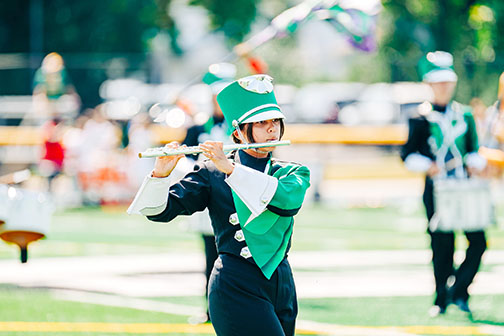
Story and photos by Patrick Olivero
By the time the first downbeat drops on a crisp Friday night, the work has been going on for months – metronomes clicking in a band room, drill sets scribbled in pencil, and teenagers in the Two River area learning to move (and think) as one.
Ask any student who’s hauled a sousaphone across a turf field: marching band is a sport, an art and, for many kids, the place where school finally feels like home.
For Rumson-Fair Haven Regional High School band director Sara Marino, Ed.D., that sense of belonging is what makes the program so powerful. “Students always come back to band in the summer with existing friendships, but then they make new friendships, really even the first week at band camp, and many of those students go on to keep those friendships for life,” Marino said. The sense of belonging, she added, is as essential as the music itself.
“They walk into high school already with a community of people that they know, which is a great starting point,” explained Beth Lyon, who has directed the Middletown High School North marching band for 17 years and now serves as president-elect of the All-Shore Band Directors Association. That head start, she said, can ease the often overwhelming transition to high school.
“It definitely has introduced me to a lot of people I wouldn’t have met otherwise,” said Amalia Foster, an RFH junior. “It’s one of the most supportive environments I’ve ever been in, especially at competitions. All the other bands cheer each other on. You meet new people, and it’s just a lot of fun.”
For Shea Kennedy, the draw is community. “It’s a good place to find other people with super niche interests like me that I don’t always find in the rest of the school,” she said.
The marching arts deliver friendship and camaraderie but also demand resilience and discipline. Students are expected to memorize music, learn drill and keep up with a rigorous schedule of rehearsals and performances.
“Being in the band world, we have a phrase: Early is on time, on time is late, and late is unacceptable,” Lyon said. “That (discipline) translates into the rest of their life.” Students receive a detailed calendar months in advance, giving them practice in organizing schedules and balancing commitments, skills that benefit them well beyond the rehearsal field.
That structure often pays dividends in academics. Studies consistently show students engaged in instrumental music tend to perform better in subjects like math and English. At Middletown North, Lyon has seen that connection firsthand. “This past year, the valedictorian was a concert band player, and another six out of the Top 10 (students) were also music kids,” she said.
Marino has observed similar patterns in her students, though she emphasizes that music should not be valued only as a tool for academic gain. “The inherent benefit of participating in music and how it enriches your life is as important as any side benefits,” she said.
The lessons stretch far beyond academics. Students learn teamwork in its purest form – each march, note and set only works if everyone is present and engaged. “It’s definitely the biggest group project you’ll do this year in school,” Marino said. “Each person is important, and I think students really appreciate feeling needed in that way.”
Amalia has experienced those benefits. “Playing an instrument teaches you to work through frustrating patches. You repeat things over and over until you get them right, and that process helps you in academics, too. You know you’ll get through it if you stick with it.”
Still, the balance is not always easy. Shea admitted that the time commitment has been her biggest challenge. “Sophomore year, I had a lot of homework, and it wasn’t all getting done because of band,” she said. “But I pulled through, and having friends in band who also wanted to do homework together helped me a lot.”
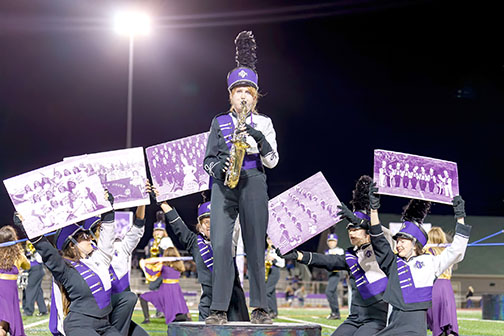
The lessons extend outside the classroom and off the field as well. Marching bands play a vital role in school and community life, providing a soundtrack for football games, parades and celebrations. Lyon recalled taking her students to Disney World’s Imagination Campus earlier this year, where they recorded music for animated films in a professional sound studio. “It was so unique, something I could never have given them here at home,” she said. “They represented not just our school but New Jersey.”
The band has also performed locally at events like AT&T’s Middletown campus celebration, underscoring the ensemble’s role as community ambassadors.
Parents and volunteers are key to making these experiences possible, whether by fundraising, moving equipment or cheering from the stands. “We can teach music without parent involvement, but we can’t have successful marching bands without the help and dedication of parents,” Lyon said. Marino agreed, noting that even small gestures, like bringing food or helping with uniforms, strengthen the program.
However, neither director shies away from acknowledging the challenges inherent in building a successful program. Both described the difficulty bringing students back into music after the pandemic disrupted early exposure to instruments and ensemble work, creating a “COVID bubble” of students who missed the chance to start instruments in elementary school. Recruiting and retention are now ongoing efforts. “It feels like a big responsibility every year to make sure as many students as possible have that opportunity,” Marino said.
But for students like Amalia and Shea, the rewards are clear. Amalia still remembers her first nighttime competition in eighth grade. “It just clicked. Everyone became really good friends so fast, and it felt like everything was falling into place. I knew I belonged.”
For Shea, the joy is in performance. “It’s nervous but exciting to see how we measure up to other bands and to see how good we are compared to others.”
At the heart of it all, though, are the everyday moments – the laughter during late-night rehearsals, the companionship on long bus rides, the thrill of a clean run-through. “There’s really no feeling like that moment of being on the field, performing for a crowd of people who are there to see you and appreciate what you do,” Marino said.
Whether it’s the thrill of competition, the pride of donning a uniform or the friendships forged along the way, marching band continues to leave a lasting imprint. As Marino put it, “It feels great to work hard and accomplish something with other people who care about the same things you care about. That pride in your work, in your uniform, and in your team is something students carry with them.”
The article originally appeared in the August 28 – September 3, 2025 print edition of The Two River Times.