By Emily Schopfer
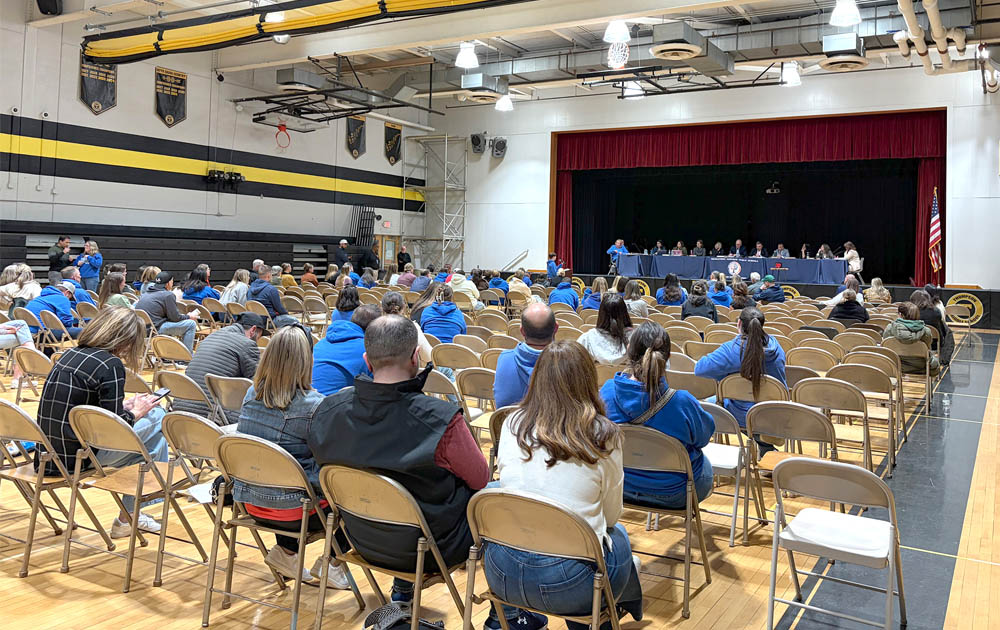
MIDDLETOWN – In a 5-4 vote at its April 28 meeting, the Middletown Board of Education (BOE) approved a $201 million final budget for the 2026-27 school year, but failed to pass a long-range facilities plan.
Less than 24 hours later, a letter to the community from BOE President Chris Aveta and Superintendent Jessica Alfone appeared to suggest the district would postpone the closure of two schools and the repurposing of a third, leaving township residents with more questions than answers.
In February, the board decided to close Leonardo and Navesink elementary schools and convert Bayshore Middle School into a new Bayshore Elementary School for those students. The former middle school students would transfer to either Thompson or Thorne middle schools.
“We are recommending that the Middletown Township School District not implement the planned school closings and consolidations scheduled for the 2026-2027 school year,” the April 29 letter read. This about-face was made as a “direct result of the Board’s failure to adopt the Long-Range Facilities Plan at last night’s meeting,” the letter said, even though the board will be re-voting on the facilities plan for its May 12 special voting and rehire meeting.
Long-Range
Facilities Plan
At the April 28 meeting, Allen Barnett of BWS Architects delivered the long-range facilities plan (LRFP) presentation. According to the presentation, an identical floor plan for both Thompson and Thorne middle schools allows for a maximum capacity of 25 students in each of the 47 general education (math, history, social studies, etc.) classrooms, split between two floors.
The 25-student capacity includes projected transfer students from Bayshore.
But Board member Erin Torres, who voted against the school closures in February, as well as the final budget and long-range plan April 28, said her concerns lied with special education students.
“I think there is a major error here that someone needs to address,” Torres said.
“This does not include our special ed population,” she said, “so how can we vote on it tonight if we don’t have the numbers for our special ed students?”
Board member Joan Minnuies, who also voted against the school closures, the final budget and the LRFP, seconded those concerns.
Barnett explained that special education classrooms are “separate from the gen-ed classrooms.” The 25-student capacity applies only to general education, he said, based on “projected population.” Capacity numbers or projections for specialty programs (science labs, music rooms, etc.) and special education classrooms were not provided in the presentation.
Torres also raised concerns that In-Class Resource (ICR) special education students who are in general education classrooms with a 1:1 aide ratio were not counted in the 25-student capacity, but Barnett said ICR students were included in the calculation.
The board voted 5-4 against the facilities plan. Voting in favor were Aveta, Frank Capone, Jacqueline Tobacco and Sara Weinstein. Voting against the plan were Torres, Minnuies, Mark Soporowski, Caterina Skalaski and Deborah Wright. Later in the meeting, Skalaski said she was considering reversing her vote.
“In absence of the long-range facilities plan being approved, there is no chance that the county will approve the school closure plan,” Alfone said at the meeting.
Budget and
Backlash
Board members Aveta, Skalaski, Capone, Tobacco and Weinstein voted to approve the $201,445,922 budget, while Torres, Soporowski, Minnuies and Wright voted against it. This vote mirrored the board members’ February voting record on school closures.
“We’re just throwing our kids into this with no time,” Minnuies said. “My opinion is we need other cuts from the top. We have heard from every level of the public; we should be cutting positions in central office that don’t directly deal with our children… We should be doing this before we even consider closing schools.”
Torres asked fellow board members to offer insight into the need for school closures. She noted that it appeared from the presentation that the budget could be balanced without the closures.
No one on the board responded, but there was a shout of, “Silence speaks volumes,” from the audience.
“This is not thoughtful planning, this is not student-focused decision making; this is disorder,” Soporowski said. He called the budget plan “unacceptable” and received applause from the audience.
Board division and animosity peaked when Soporowski directly called out Aveta, Skalaski, Capone, Tobacco and Weinstein. “We owe this community better,” he said.
The division on the gymnasium stage did not extend to the audience, however. Those in attendance were seemingly unified in their criticisms of the board’s lack of transparency, saying they have lost trust in the board.
Leonardo resident Jake Stetson recalled that five years ago, Aveta was a tremendous help to him and his wife when they asked the board to allow their daughter to remain at Leonardo Elementary. “It’s just really sad to see how we were so thankful for you merely five years ago, and now each meeting you stay silent each time we talk about the impact to students.”
Resident Samantha D’Alessio said it seemed last year’s 10% tax levy increase “was weaponized as a tool to divide the town, to push this plan down our throats, when it was intended to give breathing room to build a strategic, long-term plan.”
“Redistricting may be what’s needed,” she said, “but our children deserve an actual plan.”
“Four members of the board and the community have repeatedly asked for some – any – explanation from the five members voting to close our schools as to why this needs to be done now,” said resident Mithra Busler.
“These requests have been met with silence,” Busler said.
He felt the school closure plan was handled in “such an obviously rushed, careless, reckless and, I would say, brutal manner.”
“I’m a little tired of the nastiness that goes on in this room,” Tobacco said in response to audience commentary. “Everyone up here is trying to do the best thing. Everyone up here is a friggin’ volunteer and you people are so obnoxious and rude.”
Tobacco, seemingly looking to end the discourse, asked if any board member who voted against the LRFP would change their vote, prompting Skalaski to say she would reconsider hers.
To stave off that action, for the second time that evening, Torres proposed a motion to adjourn the meeting, which did not pass.
Skalaski formally moved to reconsider her vote, a motion that passed, resulting in an all-out argument over fairness, ethics and the legality of the decision. The motion was ultimately ruled out of order as it was made after public comment, and the LRFP did not pass.
The board is holding a special voting meeting Tuesday, May 12, during which it will revisit the LRFP.
The Numbers
According to the final budget presentation delivered at the April 28 meeting by Amy Doherty, the business administrator and board secretary, the approved 2026-27 school year budget includes the 3.07% tax increase proposed March 24, comprised of the 2% state-allowed annual increase and a 1.07% healthcare cost adjustment. This adjustment was approved by a board majority vote in March.
The new tax levy will provide the district with a little over $182 million in revenue, accounting for over 90% of the roughly $201.5 million budget.
The 2026-27 levy increase is significantly lower than last year’s 10.1% levy, but for a Middletown home valued at the municipal average of $785,000, the increase would equate to $223 more a year, Doherty said in March.
There was no change in state aid between the tentative and final budgets; the district will receive $15,719,251 in state aid for the 2026-27 school year, a 6% increase (almost $890,000) over last year. State aid will make up slightly less than 8% of projected revenue.
One change from the tentative budget presented March 24 is the reallocation of $360,000 from budgeted maintenance reserve to equipment and projects funds. This includes $100,000 for new playground equipment at New Monmouth Elementary, and $260,000 at Bayshore Elementary for a new playground and kindergarten bathroom.
Doughtery said April 28 that the school closures and conversion will save the district approximately $3 million, and this was factored into the $201.5 million budget.
Next Steps
“The resolution to close schools is separate from the budget, although the cost savings within the budget obviously are predicated on school closures, but they are two separate situations,” Alfone said in response to a question from Minnuies at the meeting.
When asked how the budget could remain balanced without the projected $3 million from school closures, Doherty said in a May 4 email to The Two River Times, “We will need to reallocate funds within our 2026-2027 (budget) to accommodate the change in direction regarding the 2026-2027 school closures,” but added that a budget re-vote will likely not be necessary as the total amount and tax levy will remain the same.
The 2026-27 budget also includes the layoffs of 40 staff members: three in administration, 25 in instructional staff, and 12 in support roles, according to the budget presentation. But Doherty seemed to contradict the budget presentation.
“While adjustments need to be made, we do not anticipate eliminating programs or staff at this time. The administration is currently reviewing options for revising our budget plan,” Doherty said in her email.
Doherty also said, “There have been no decisions on school closures beyond what the Board has considered and acted on at its meetings,” again seeming to contradict information in the April 29 letter from Aveta and Alfone.
“We simply do not have enough time to properly plan and effectuate the school closings for the 2026-2027 school year,” the letter stated, but did not say whether they want the closures to be pushed to the 2027-28 school year.
Alfone is retiring in June and her replacement has not yet been named.
The article originally appeared in the May 7 – 13, 2026 print edition of The Two River Times.