By Sunayana Prabhu
KEYPORT – During the 1980s, kids from Third Street and beyond would race their bikes to the water’s edge, skip rocks where Chingarora Creek meets the Raritan Bay, and think nothing of the Aeromarine landfill at the end of Walnut Street.
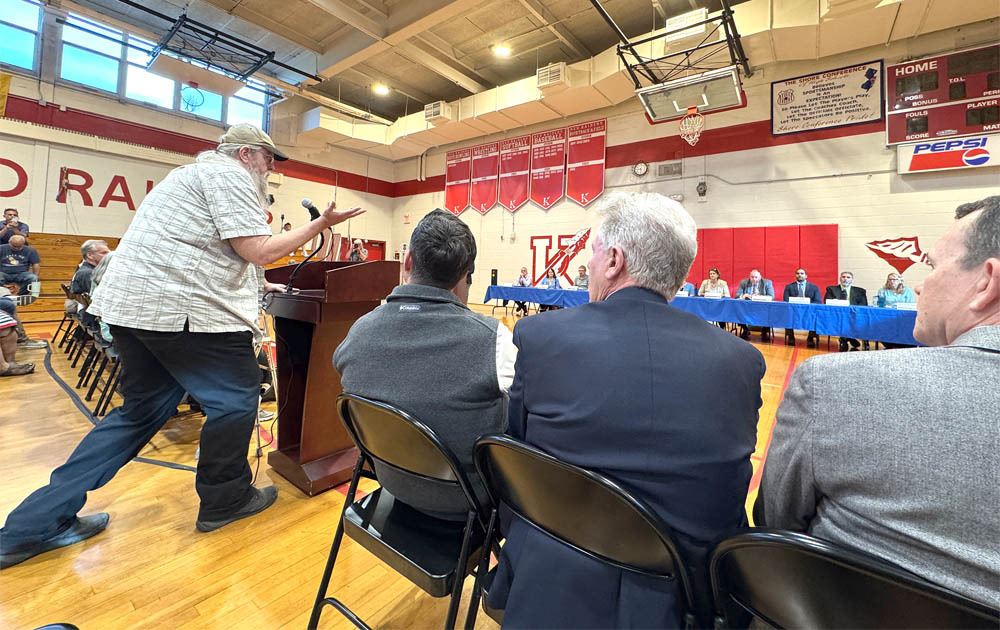
On a recent Sunday afternoon, one of those kids, Bob Lorenz, a 1988 Keyport High School graduate, stood in the school’s auditorium and told top state officials that his sister could name at least 18 people from that circle of friends and families who have had cancer.
“I’m 55 now,” Lorenz said. “I have cancer. My sister had cancer. She lost four of her friends to cancer. Now, why was there nothing done since 1979?”
Lorenz echoed the nearly 200 residents gathered at the May 17 special community meeting organized by the New Jersey Department of Environmental Protection (NJDEP) to seek answers amid speculation of a cancer cluster among residents living near the landfill. The site was shuttered in 1979, but was never properly capped for safety.
Lorenzo blamed NJDEP officials for “dodging liability” and urged them to hold owner Bay Ridge Realty Co. liable before the property is sold to Pacer Group Holdings, LLC, which wants to remediate and redevelop the site.
“Do not allow them to sell. Make them clean it up, and take them to court; sue them, get the attorney general, get New York involved,” Lorenzo said. “I don’t really think you can do anything to help us, but I would really like you to start collecting cancer cluster research, because this is a cancer cluster.”
For more than two hours, residents spoke about an alarming pattern of illness in and around the low‑lying neighborhoods of Chingarora Creek and Keyport Harbor.
Resident Nicole Henn said her 12‑year‑old daughter was diagnosed in 2022 with an “extremely rare” cancer. She noted at least four more cases on her block.
Others spoke of neighbors with Parkinson’s disease without known genetic markers, and of blocks where “every neighbor” has had cancer.
Several residents said the town’s history with the site has eroded trust in both its owner and the agencies that regulate it.
The nearly 60-acre property, owned by Bay Ridge Realty Co. since the 1960s, was once home to Aeromarine, a seaplane builder and airline operating to the Caribbean. The plant closed in 1937. About two-thirds of the site has remained a defunct landfill since Aeromarine’s exit. Bay Ridge has been leasing the remaining property to multiple commercial businesses, including auto repair, manufacturing and storage units.
The landfill is surrounded by nearly half a mile of Raritan Bay shoreline. When Bay Ridge bought the property, the NJDEP required cleanup, which has not yet been completed. The NJDEP ordered the landfill closed in 1979 due to longstanding operational and engineering issues, but it was never permanently closed, state officials confirmed.
The NJDEP last investigated the site in 2010 and found toxic chemicals were leaching into the Raritan Bay from the landfill area. In 2024, evidence of arsenic and lead was found on the beach at the end of Walnut Street, various officials and residents confirmed.
While contaminants from the Aeromarine site have been a longtime concern, there has been no scientific evidence so far linking them to cancer cases, Keyport Mayor Rose Araneo said during an April 12 meeting. Concerns had been raised again by a former resident on social media who connected cancer cases to the landfill’s proximity.
At the May 17 meeting, NJDEP officials, along with those from the New Jersey Department of Health (NJDOH), pledged greater testing, data review and public communication in response to mounting public and political pressure. Reports are expected to be available by the end of June.
“Our ultimate objective for this site is to ensure that it’s properly closed, and the new testing results are going to help guide the requirements for that closure,” Ed Potosnak, acting environmental commissioner, told frustrated residents.
“Bay Ridge Realty is responsible ultimately for properly closing the landfill and to ensure that waste does not contaminate the surrounding soil, groundwater, or surface water,” Potosnak said. “Our role at the Department of Environmental Protection is to oversee that closure and the post‑closure maintenance and monitoring of that inactive sanitary landfill.”
U.S. Rep. Frank Pallone (D-6) and state Sen. Declan O’Scanlon (R-13) joined state officials at the meeting as residents demanded to know whether toxins from the roughly half‑century‑old landfill have been causing cancer in their community for generations.
Old Data Needs Updating
NJDEP officials said Keyport’s public drinking water, supplied by two deep municipal wells and supplemented by the New Jersey American Water Company reservoir, is routinely monitored and meets state and federal Safe Drinking Water Act standards. The public wells are hundreds of feet deep and lie beneath a confining geologic layer that prevents surface contaminants from reaching the aquifer, officials said.
“Given this data, the department finds no drinking water exposure pathway or impacts to drinking water,” said Kati Angarone, the NJDEP’s chief strategy officer.
Angarone walked residents through the 2010 remedial investigation, which found that the existing soil cover over the landfill “did not meet minimum closure requirements.” Arsenic, which is “naturally occurring” in the area, was detected above state soil remediation standards, she said.
Some contaminants above state criteria were found in groundwater monitoring wells, although there is “no evidence at the time of impact to public drinking water,” she said.
Methane and volatile organic compounds, including benzene, were found in soil gas at depth inside the landfill, Angarone noted. The study concluded that there was no “apparent exposure pathway” off the site and therefore no further investigation was warranted.
That data is now 16 years old. “In a landfill, we would expect levels to stabilize or improve, not worsen, but out of an abundance of caution, we are collecting new data now,” Angarone said.
There are now three parties testing the site – the NJDEP, the NJDOH and the prospective buyer, Pacer Group Holdings, LLC. Through its engineer, CESI Consulting Engineers, Pacer has obtained an NJDEP permit to conduct new environmental testing. Work to prepare and rehabilitate existing monitoring wells began in recent weeks. Sampling is expected later this month, with results anticipated about three weeks after collection.
The NJDEP will conduct its own “third‑party verification” sampling in addition to the consultant’s work, Angarone said. The agency will also sample surface water in Keyport Harbor and surrounding streams, with completion targeted by June.
Potosnak said the NJDEP is treating the issue as a priority.
“We are working very fast. We have made it a high priority to do everything that we can to get results, new testing data out to the community,” he said.
Angarone said all data, including raw groundwater monitoring results, will be posted on the NJDEP’s website at dep.nj.gov/keyportlandfill.
Evidence of Exposure Needed for DOH Study
Officials from the NJDOH and the federal Agency for Toxic Substances and Disease Registry told residents they can’t declare a cancer cluster tied to the landfill yet.
“Our very first step is reviewing the environmental data,” said epidemiologist Kate McGreevy, the program manager for the state’s Environmental and Occupational Health Surveillance program. “We need to know what geographic area was impacted, if there are off-site impacts, because that tells us who was impacted. We need to know what contaminants people were being exposed to, because different contaminants can cause different adverse health impacts.”
Using new sampling data, the NJDOH will determine whether there are “exposure pathways,” officials said, such as contaminated drinking water, indoor air affected by vapor intrusion or direct contact with polluted soil. They will assess whether those exposures are high and long‑lasting enough to cause cancer or other health effects. Only then will data from the New Jersey Cancer Registry be examined for patterns among residents in the defined exposure area.
McGreevy cautioned that pulling cancer statistics for all of Keyport without first knowing who was exposed and to what could dilute or obscure a true signal.
“Just looking at all cancers combined in areas that may not have had an exposure pathway is not going to provide us with any information,” she said.
Enforcement and a Long‑Delayed Closure
Many residents also wanted to know why Bay Ridge Realty has not been forced to complete the closure of the site and what will happen if the firm lacks the money to remediate or walks away.
According to NJDEP officials, between 2021 and 2025, the agency issued four administrative orders and penalty assessments against Bay Ridge, including more than $1.2 million in fines, for failing to properly close and maintain the landfill.
“The company was not really heeding the message,” said Michael Hastry, director of Waste and Underground Storage Tank Compliance and Enforcement.
Those orders are now consolidated before the Office of Administrative Law, with a case management conference scheduled for June 2, NJDEP officials said. The agency is working with the state attorney general’s office to “use all legal avenues” to accelerate the case, Hastry said.
When some residents asked what would happen if Bay Ridge refuses to act, NJDEP officials said options could include seeking court orders or using other legal tools, but did not commit to a specific fallback plan or state-funded takeover.
“There’s really no easy answers,” Angarone said.
The article originally appeared in the May 28 – June 3, 2026 print edition of The Two River Times.