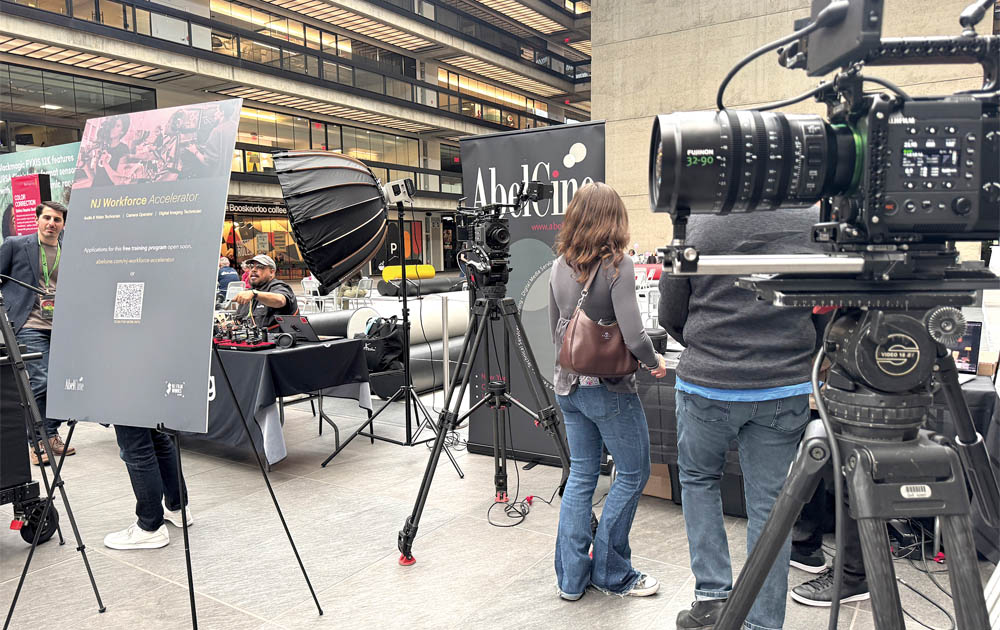
The 2026 Monmouth Film Festival kicked off three days of film screenings, workshops and a digital film expo May 29 through 31 in Bell Works’ central atrium. Photo by Sunayana Prabhu 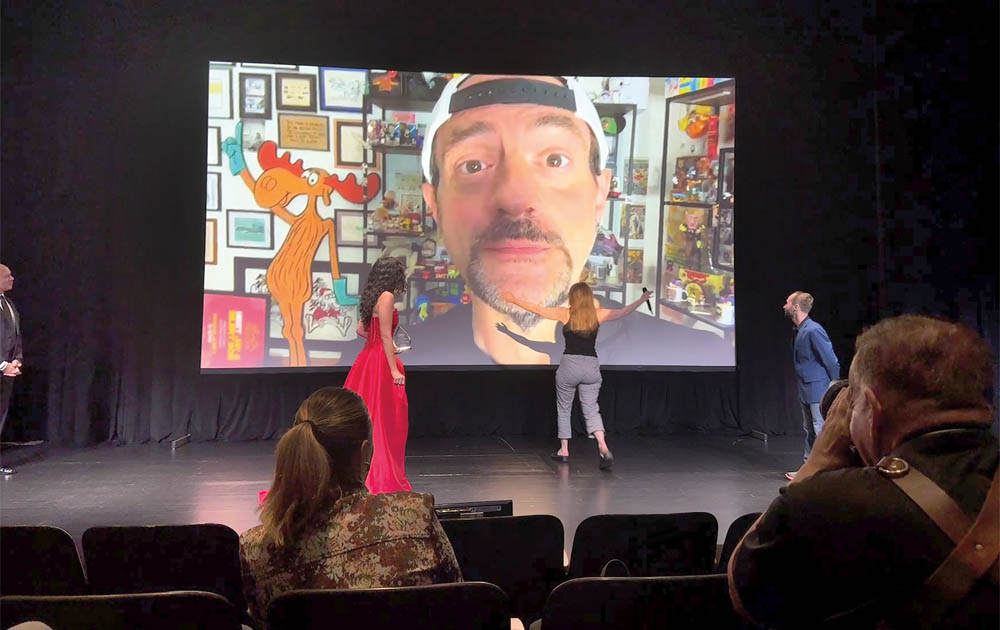
At the Monmouth Film Festival in Holmdel, the Kevin Smith Director Award went to Rose Trimboli for her film “You Know What You Are.” Smith spoke via video to audiences during the festival’s award ceremony last month. Photo by Sunayana Prabhu 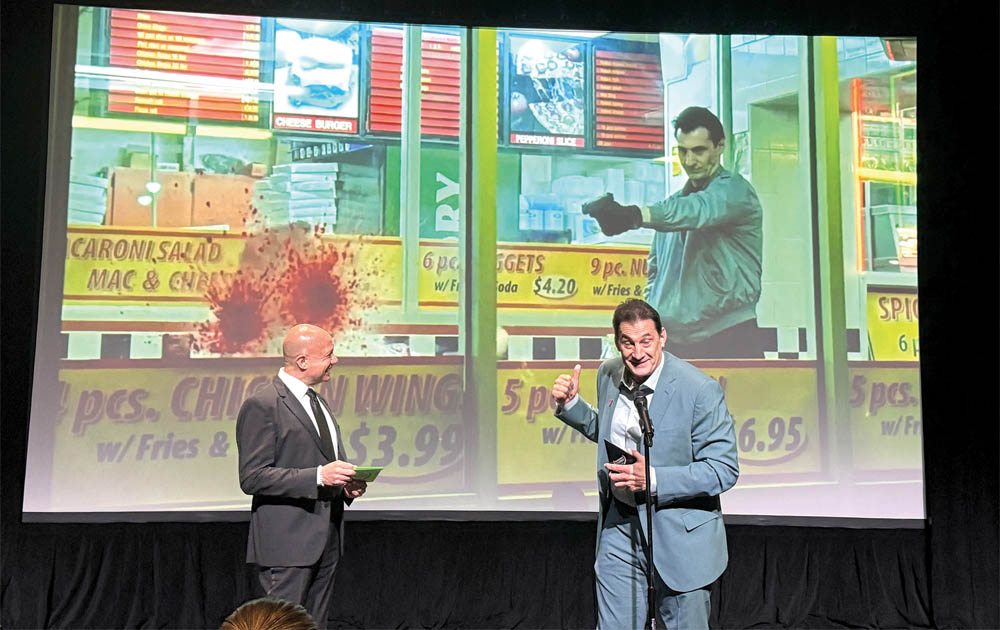
Actor Robert Funaro, known for his work on “The Sopranos,” and Eric Eremita, a celebrity contractor and designer known for his appearance on HGTV’s “Love It or List,” at the 2026 Monmouth Film Festival awards ceremony at Bell Theater, Bell Works, Holmdel. Photo by Sunayana Prabhu
By Sunayana Prabhu
HOLMDEL – As the red carpet rolled out at Bell Works, the venue that brought Apple TV+’s series “Severance” to life was transformed into a bustling hub for filmmakers, industry professionals, students and educators for the return of the Monmouth Film Festival (MFF) after a five-year hiatus.
The three-day festival, May 29 to 31, drew thousands of attendees amid an upswing in New Jersey’s film and television industry, a trend increasingly dubbed by industry insiders as “Hollywood East.”
“Roughly about 3,000 people participated,” Holmdel resident and MFF founder Nicholas Marchese said outside Bell Theater in Bell Works as the festival concluded its run. “The opening day alone had about 1,500 people coming through.”
The festival originally ran from 2016 to 2019 in Red Bank, then shifted to two years of virtual programming during the COVID pandemic before pausing. Its return at Bell Works marked a renewed commitment to both local audiences and international filmmakers, Marchese said.
“We go all over the world, all over the country, and find some of the most prestigious independent stories, independent filmmakers, and bring them together here in New Jersey.”
The festival featured more than 50 films, along with 14 panels and workshops offered free of charge and attracting standing-room-only crowds throughout the weekend.
The creative energy throughout the festival reflected New Jersey’s ascent amid major studio investments and a growing production infrastructure, largely driven by the state’s nearly 40% tax credit program. Several big players are now pouring concrete – Netflix is constructing 12 soundstages at the former Fort Monmouth, Paramount is developing facilities in Bayonne, and Lionsgate is building in Newark.
“The uptick has been a serious one,” said attorney Alexandru Aldea, who specializes in entertainment law. Aldea participated in a panel discussion on industry trends. “We’re now No. 3 in the United States for filming destinations,” with New Jersey’s tax breaks running through the year 2046. As a result, making a movie is “not a pipe dream” anymore, Aldea said.
According to the NJ Motion Picture & Television Commission, film and television production spending grew from $592 million in 2023 to $834 million in 2024. More than 550 productions were filmed in the state in 2024, generating more than 30,000 crew hires statewide.
Trends to Watch
The impact of this growth is evident beyond filming locations and was palpable at the MFF. Randi Davis, an adjunct professor at New York University’s Tisch School of the Arts, told attendees to stay open to evolving trends when launching a career in the industry. “We’re going to see the industry continue to morph into a whole different thing. I really think that shorts are going to be the norm,” Davis said.
To those thinking about creating content now, “you really have to think from this new lens. The future is short-form,” she said, referring to “verticals,” or three- to five-minute stories made for cellphones. User-generated content, “which we’ve had for decades with YouTube, is becoming more sophisticated and highly produced; people have studios in their basement,” Davis, a Marlboro resident, said. “Your real competition isn’t Netflix or Amazon anymore,” she added. “It’s the other people like yourself making content.”
The excitement tied to opportunities in the growing film business attracted industry professionals, many of whom traveled from New York and California specifically for the festival.
Actor Robert Funaro, known for his work on “The Sopranos,” told hopeful actors, “Don’t turn jobs down.”
Recounting how an early role alongside actor James Gandolfini eventually led to his casting on “The Sopranos,” Funaro said, “If you get a job, don’t deny it, even if you’re not working for money. It’s who you meet.” He also recommended the Actors Access subscription service as an entry point for novice actors seeking non-union auditions and on-set experience.
Technology and Other Growth
The Digital Film Expo set up throughout the Bell Works atrium featured leading industry vendors, including AbelCine, Blackmagic Design and I.D.X., among others. The companies showcased professional cameras, production equipment and emerging technologies to filmmakers eager to capitalize on the state’s expanding production ecosystem.
Jeff Lee, director of Education and Product Specialization for AbelCine, noted that overall the film industry is “starting to rebound, so we’re optimistic that things are trending upward.” He also acknowledged a definite downturn in the past due to several factors like the COVID pandemic, the Hollywood trade union strikes, and even the California wildfires, “which pushed a lot of international work overseas. But now we’re beginning to see some of that work return, or at least see studios making a real effort to keep more production domestic,” Lee said.
To address production growth in New Jersey and the demand for professional-grade equipment and training opportunities, AbelCine is offering a workforce development workshop with three separate tracks: Camera Operator, Audio Video Technician, and Digital Imaging Technician.
The outlook for studio growth in New Jersey was also a topic.
“In the past couple years, there’s been a migration of production where L.A. used to be the place and then as prices were rising we saw production teams going to Vancouver, some into Toronto, and now into the U.K.,” said Tom Yuhas, national sales and marketing manager of I.D.X.
He noted that New Jersey’s success remains closely tied to its film tax incentive program. The studios are building “because we have a tax benefit that makes it worthwhile,” Yuhas said. “It’s positive for the state. I just hope that the governor doesn’t change it.”
Financial services company Prudential maintained a presence among the camera rigs, lighting systems and production equipment, offering guidance to creative professionals navigating the financial realities of careers in the arts.
“A lot of the people that work in the industry are contractors, and so they can go two months with a good job, make some money, and then they don’t have a job. So we try to help them be comfortable financially,” Armando Krusell, a Prudential representative, said, adding that the company offers financial literacy to sustain a creative career.
The Movies
MFF partnered with Lionsgate Studios to launch the opening-night premiere of “Power Ballad,” starring Paul Rudd and New Jersey-native Nick Jonas at Cinemark, Hazlet. The premiere kicked off two consecutive days of the film festival at Bell Works with a lineup of curated shorts, documentaries and feature films created locally and around the globe, including “Vienna,” an emotional exploration of a family coping with the tragic loss of a child to Sudden Unexplained Death in Childhood (SUDC), which won the festival’s Audience Award; “Greetings From Seaside Heights,” a documentary examining the complexities of seasonal tourism through the voices of locals and visitors; and “Twas The Night,” a darkly comedic short following a mischievous creature that escapes Santa’s bag on Christmas Eve.
MFF’s feature film lineup included the award-winning “Untouchables,” the inspiring story of Newark fencing coach Derrick Hoff and his championship-winning team. The film won Best New Jersey Film at MFF. “You Know What You Are,” a chilling New Jersey-set horror feature that reimagines vampire mythology in a desolate winter beach town, won the newly instituted Kevin Smith Director Award. Highly anticipated titles, including “Power Ballad,” “I Want Your Sex” starring Olivia Wilde, and “Union County” starring Will Poulter, were also shown.
The festival also showcased acclaimed international selections, including “Happy Birthday” from Egypt and “HEN” from the Mediterranean region.
The festival concluded with a tribute to past board members and a commitment to continued growth and community engagement. “The film scene has changed a little bit over the years,” Marchese said. But he added that “our mission has not changed; it only got bigger.”
The article originally appeared in the June 18 – 24, 2026 print edition of The Two River Times.