By Gianna Puglisi
The 2026 FIFA World Cup’s 39-day stretch of matches is winding down this weekend, with the final taking place in New Jersey July 19.
But the setting of the final and a few other matches is not all New Jersey had to offer the tournament – it’s also a center for turfgrass breeding and provided pitches for 10 of the 16 North American stadiums in use this summer. The Two River Times explored the Freehold farm behind soccer’s biggest stage.
C. Reed Funk established Rutgers University’s Plant Science Research and Extension Farm in 1962. The farm currently spans 200 acres in western Monmouth County and experiments with 10 different turfgrass breeds, maintaining over 51,000 turf plots and providing grasses for lawns and fields in a wide range of varieties, according to farm director and Rutgers professor Stacy Bonos.
The farm tests for several stressors, such as heat, drought and disease, to facilitate selection and create the most durable cross-varieties of grasses. A primary focus for farm staff as they prepared the grass for the World Cup, however, was wear and tear.
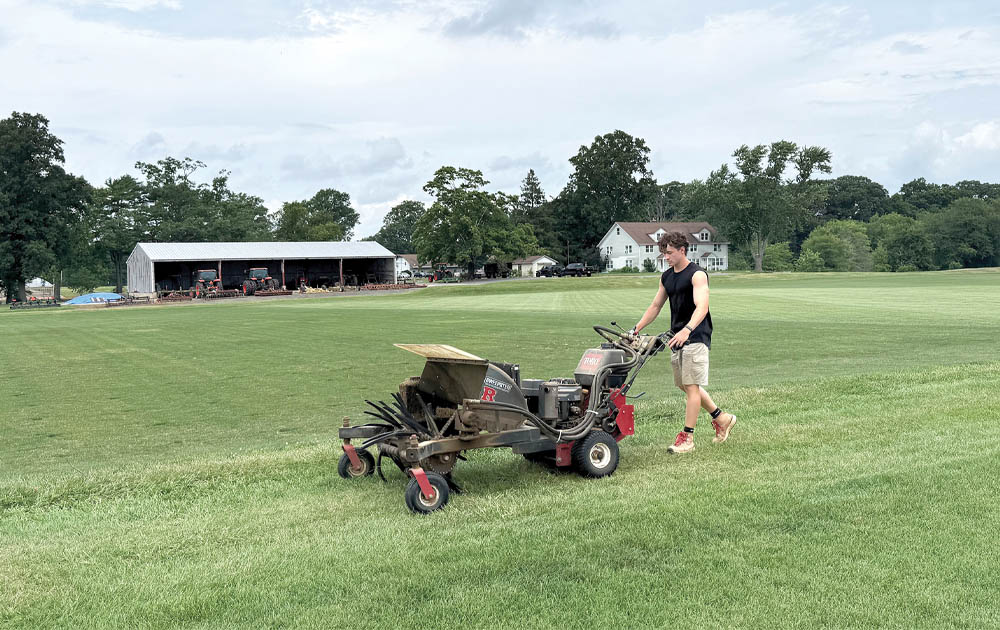
To test the grass in a close comparison to a full-length soccer game, Bonos and her team modified a Sweepster machine (usually used on hard surfaces for cleaning debris), replacing its typical broom with hard rubber paddles that slap the grass. The action is meant to simulate soccer cleats colliding with a pitch. Over time, grasses change in response to their ability to withstand the machine’s passes. Those that survive then face continued tests of other stressors and, based on their performance, are considered “parent strands.”
“You’re guaranteed to see some kind of improvement by picking those parents and crossing them and looking at the next generation,” Bonos said. “Once you find a good one, it’s good forever.”
Bonos said the farm specializes in cool-season variety breeding, meaning the grasses survive in cooler climates such as those in the northern United States. But New York New Jersey Stadium opted to use a warm-season variety, not Rutgers-bred, for the tournament.
As climate shifts persist, the farm has also begun researching warm-season grasses.
“We have to be thinking basically like 10 years out, because that’s how long it takes to develop a variety,” Bonos said. “We’re already seeing warm-season grasses creep up further and further north… we need to be ready as a plant breeder.”
James Murphy, an extension specialist of nearly 35 years in Rutgers’ Department of Plant Biology, said he’s happy with how Rutgers’ turf is holding up. “I am very pleased to see that the sports field managers and the Rutgers grasses are producing playing surfaces that are performing extremely well,” he said. “I watch when the players are running full speed and then suddenly stop, pivot or slide. An excellent surface will support that activity without failing.”
Bonos noted that Rutgers turfgrasses account for about 35% of global grass seed production and use. She said they maintain partnerships with 25 international seed companies, and their grasses have been used in Super Bowls, at Yankee Stadium and on the White House lawn.
As the World Cup comes to a close, Murphy looks forward to implementing feedback into his practices. “We are looking for ways to improve grasses and to manage those grasses. We are always listening and watching for insights gained from the sports field managers or the athletes during events like the World Cup. You never know when you will pick up some information that makes a difference, but you are always on the alert for it.”
The article originally appeared in the July 16 – 22, 2026 print edition of The Two River Times.