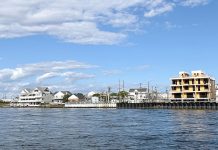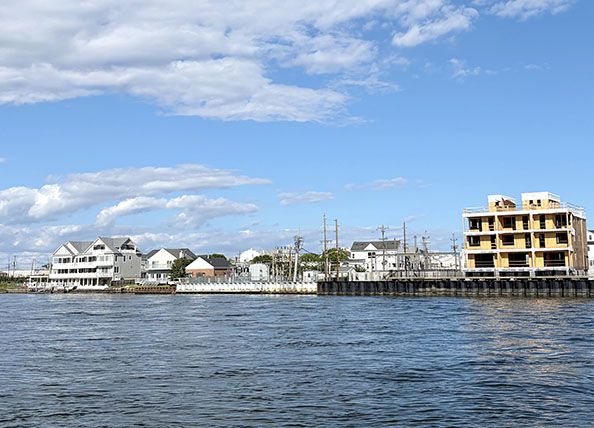
Sea Bright’s existing bulkhead includes 840 linear feet of new steel bulkhead in front of The Haven development. Sea Bright Borough Council stressed that a planned flood mitigation project isn’t designed to protect Sea Bright from another Super Storm Sandy. What the borough hopes to protect against is frequent flooding between the “Sandys.” Emily Schopfer
By Emily Schopfer
SEA BRIGHT – The barrier peninsula of Sea Bright has long battled the elements. But as flooding becomes more frequent and severe, the borough proposed a solution: a new bulkhead along the bay, as part of its Sea Bright Flood Mitigation Project.
The borough council introduced a $2.5 million bond ordinance aimed at bulkhead improvement at its July 21 council meeting. The bond would fund the project which, if approved, would provide new check valves, pump stations and roughly 1,350 feet of bulkhead.
Community Feedback
The council had planned to vote on the Flood Mitigation Project following a Town Hall meeting Aug. 18, but decided to push the vote to Sept. 15, as the packed meeting turned into a public hearing on the project.
“Our bulkheads are deteriorating. There’s no doubt about that,” said resident Kevin P. Birdsall, but “the question before the council tonight is not whether to act, but how to act lawfully.” Birdsall noted “significant legal risks in the proposed funding,” and suggested a special assessment district, where property owners pay extra tax to support projects that benefit their area, as an alternative.
“Why the sudden push to transfer the burden to the entirety of Sea Bright’s residences when it is very possible that in the near future, we will have legal pathways to enforce property owners to shoulder this cost?” Birdsall said.
One of the property owners impacted by the bulkhead, who identified himself as Lance, said he is “100% against this project.” Lance said the bulkhead will increase flooding on his property, and he has already seen “higher water during west winds, which is very unusual.”
“I will take legal action necessary to prevent this project from going forward,” he said.
Resident Tim Kerner spoke in favor of the project, “for our fire, safety, EMS… (who) go out in knee-high water with threat conditions of electricity.”
“You do it for the first responders,” Kerner said. “Economically, it was shown here tonight that it could work. And then finally, you do it for the businesses in town, or else we’re going to look like a town that’s vacant.”
Charlie Rooney, a longtime resident and son of the late Charles Rooney Jr., a former Sea Bright mayor, remembered that when he was young, the ocean would come over the sea wall, but beach replenishment resolved this issue. “Now our battle is the river. It’s a no-brainer,” Rooney said. He is adamantly in favor of the project.
“Little by little, this town of Sea Bright, because we are a barrier island, is going to go under the water if we don’t do what we need to do,” he said. “We need to really think hard about passing up this opportunity.”
Resident Linda Lamia recalled the impact riverside flooding had on Sea Bright during Super Storm Sandy, and how, during that time, one of the “No. 1 things that people wanted was a bulkhead in this town. This is 14 years later, we have an opportunity, the moment is now. If we lose it, it’s over,” she said.
Lamia also spoke of the difficulty she faces as an emergency room nurse commuting to work on Ocean Avenue.
“I’m going to say something that might seem a little bit harsh, but the needs of the many outweigh the needs of the few,” said resident Paul Pilsbury. “It is the heart and soul, our downtown.”
“There’s pros and cons to this project,” but “one thing you can’t object to is preventing something that might be a disaster,” said Danny Heller, a property owner in the downtown area.
Another issue raised Aug. 18 concerned river water simply going around the ends of the bulkhead, but the borough council assured residents that would not happen because the bulkhead would be built to taper off at the two higher land elevation points at both ends.
Council member Erwin Bieber, chair of the Flood Mitigation Committee, addressed the idea that the public was “blindsided” by the project. He said the project has been discussed for years at public council meetings.
“In my mind, and I believe the council feels this way also, flood mitigation and protection is one of the most important things we have to pay attention to in this town,” Bieber said. He presented the project Aug. 18.
“We sit between the ocean and the river, and we know they both represent the greatest risk to us.”
Project Overview
The project plan, put together by Avakian Engineering of Neptune, is “achievable and affordable,” Bieber said. While the plan is not perfect, he said, it is “the best alternative that we believe we have to protect the entire town.”
“We all know that Sea Bright suffers from repeated flooding,” Bieber said. The flooding impacts not just residents and local businesses, but also blocks critical evacuation routes, exposes cars and property to damaging salt water, and puts first responders at risk when they must venture into flooded streets. The plan, according to Bieber, will address flooding from the Highlands-Sea Bright Bridge to Monmouth Beach.
While the proposed bond is $2.5 million, this is the “worst-case” project estimate, according to the Aug. 18 presentation. At $2.5 to $2.52 million, the project could cost property owners in Sea Bright an average of about $109 per year, or $9 per month, based on the average residential property tax of $10,160 in 2026.
The borough estimates the project will cost around $2.1 million, with property owners paying $97 per year or about $8 per month. The best-case cost scenario, Avakian Engineering’s estimate, is $1.75 million, which would result in an $85-per-year cost to the average property owner, or $7 per month.
Bieber said the borough council did try for years to “do this project with somebody else’s money, and by that I mean federal, state, FEMA,” but was unsuccessful.
The borough was successful, however, in securing legal easement agreements from the 11 owners of private property in the planned project area. The agreements grant the borough permission to install the new bulkhead along the properties until 2028, when the easements expire. Under these agreements, responsibility for maintaining the bulkhead falls to the property owners, following a one-year builder’s warranty. There is an ordinance in place, approved Oct. 20, 2020, that grants the borough the legal authority to require property owners to maintain and repair bulkheads to prevent erosion, public health hazards or adjacent property damage.
“Time is not on our side here,” Bieber said. Even with the easement agreements, the borough still needs Coastal Area Facility Review Act permits from the New Jersey Department of Environmental Protection, and “that can take up to a year,” Bieber said. If approved, project installation should start in spring or fall 2027, close to the 2028 expiration date for homeowner permissions.
Among the easement agreements, expiring borough debt, The Haven at Sea Bright development, and $37 million recently secured in federal beach replenishment, “We’re in the best position to do it now,” Bieber said. Sea Bright’s contribution to the beach replenishment for fall 2027 at North Beach will be $400,000 to $500,000, Bieber estimated. “The river represents our greatest risk, and now we’re in a position to mitigate,” he said.
North and South Beach
The project is divided into three sections. Areas north of the Rumson-Sea Bright Bridge (designated North Beach) and south of the Waterways Townhouse Community (South Beach) experience street flooding due to reverse river water migration rather than high tides.
To resolve this, the borough is working with the New Jersey Department of Transportation (NJDOT) to install check valves. The borough is bringing NJDOT into this project since Route 36 is a state highway under the NJDOT’s authority and is most often the road with the most significant flooding. In coordination with the NJDOT, eight new check valves will be installed between North Beach and South Beach. Although the NJDOT is working with the borough on this project, the department ruled in May that it has no legal authority to fund the project, according to the Aug.18 presentation.
Downtown
The project also takes Sea Bright’s topography into account, utilizing two natural high elevations on the peninsula – the bridge and Waterways. Sea Bright’s downtown area encompasses everything between these high points. The designated Downtown element of the plan includes a repaired bulkhead and new functioning check valves to hold back high tides during routine and king tides, and new pump stations to remove rainwater or sewer water. The borough already has a Check Valve Installation Plan in place and underway, with seven new valves installed, as well as three pump stations and one in progress. Eventually, the hope is for every pump station to have a generator, according to Bieber.
The new bulkhead is the missing piece of the puzzle.
The entire length of the downtown bulkhead is 2,800 linear feet, but only 1,350 feet of a 7-foot-high bulkhead is needed. The Haven at Sea Bright, the 44-unit development owned by Toll Brothers, provided 840 linear feet of steel bulkhead along the riverfront between River Street and Beach Street.
In addition to The Haven, portions of the bulkhead have already been replaced during previous borough projects and by Jersey Central Power & Light, private property owners, and during the Rumson-Sea Bright Bridge construction.
This article originally appeared in the August 27-September 2, 2026 print edition of The Two River Times.