By Stephen Appezzato
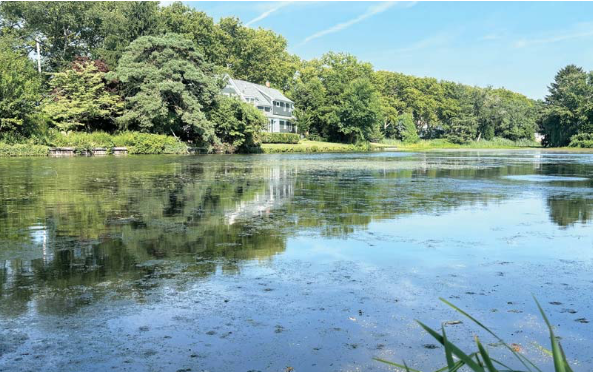
FAIR HAVEN – Borough officials are looking to fasttrack solutions to frequent issues with algae in McCarter Pond as a thick green blanket of organic matter spreads across the water.
Most years, during the summer and early fall, algae blooms coat McCarter Pond, inhibiting wildlife and plant life under the surface. This year, the issue appears particularly bad.
“This is obviously a very important topic right now. It’s timely, and we need positive intervention as soon as possible,” said Mayor Josh Halpern at the borough’s July 22 council meeting. “The pond is in a negative situation right now,” he said.
To expedite a fix, the borough council discussed forming a new McCarter Pond Committee.
“We feel time is of the essence, as far as intervention,” Halpern said. “We want to get as many options available to us as possible.”
If given the green light, the committee would consist of around seven members, dedicated solely to researching ways to treat algae bloom. Members would have access to the borough’s resources, including professionals and consultants, and would report to the borough’s Environmental Commission, which reports to the borough council. Presumably, the committee would also work alongside the newly formed Friends of McCarter Pond resident advocacy group, which extended its help and support at the meeting, to explore algae treatment and prevention routes.
Algae blooms often occur naturally in bodies of water due to warm and sunny weather which spurs plant growth. However, in residential communities, blooms are more prominent and severe due to increased nutrient levels in the water – mainly nitrogen, carbon and phosphorus – which are common in fertilizer, septic systems, animal waste and urban runoff.
Currently, 85% of McCarter Pond’s shoreline is privately owned and runoff from 45 acres around the area is discharged into the pond.
“An obvious win would be to reduce fertilization on the private land, but that’s private land so it needs to be done through education, in my sense, or recommendations,” noted council member Brian Olsen. On the remaining 15% of land, which is borough-owned, grass is only mowed and fertilizer is not used.
When a bloom coats a pond, it “shades out” other plant species that are important to the biome. Additionally, blooms prevent oxygen from mixing with pond water, lowering oxygen levels for wildlife, and can inhibit animals from finding food. In severe cases, low oxygen levels can kill entire fish populations.
In exploring solutions, borough officials met with a consultant from CME Associates, as well as Monmouth County Commissioner Director Thomas Arnone and members of the county’s public works department.
“They were pretty clear (that) in order to make it successful, you have to have a three-pronged approach” of hydro-raking, aerating and chemicals, said borough administrator Chris York.
Currently, there are six aerators in McCarter Pond that introduce oxygen and circulate the water so it can absorb more oxygen from the surface.
The borough hydro-raked the pond last year and is currently planning another raking session. Hydro-raking is when vegetative waste is manually raked from a water body to increase the amount of clear water and improve oxygen levels.
“We’ve taken out 250 tons of material hydro-raking and another phase is coming; five of the six aerators are working, but the chemicals haven’t been put in since August of ’19, so it seems like that’s the missing link,” said Olson.
He noted there are different types of chemicals that can be used, but they range widely in cost.
Council member Drew LaBarbera clarified that “chemicals” don’t mean “poison,” like shocking a pool, but work by introducing oxygen to the water. In 2019, the borough introduced MD Pellets to McCarter Pond, which release bio-stimulants and indigenous bacteria to degrade muck and algae. Another compound that might be used is GreenClean, a noncopper-based algaecide that also introduces oxygen into water as it biodegrades, and is safe for plants and animals.
Halpern said the governing body and the McCarter Pond Committee must be “reasonable with the expense side of things and what it costs to do things,” but also that the pond looks as bad as he could remember. In the coming weeks, it is very likely the new committee will be established to help officials find an algae solution.
The article originally appeared in the August 1 – 7, 2024 print edition of The Two River Times.