By Emily Schopfer
NEW JERSEY – The Long Branch-based nonprofit Clean Ocean Action (COA) filed a lawsuit July 20, appealing the approval of a Utility License granted by the New Jersey Tidelands Resource Council (NJTRC) to the Williams/Transco Northeast Supply Enhancement pipeline, commonly referred to as NESE. The approval was granted July 17. The lawsuit states that the NJTRC has a legal obligation to serve New Jersey’s interests and, in approving this license, failed in its responsibility to the state.
COA is one of the state’s leading environmental nonprofits, focusing heavily on water quality off New Jersey and New York coasts. The organization announced the lawsuit in a news release. The lawsuit is technically against the State of New Jersey because it specifically targets a state agency, the NJTRC, which is a division of the New Jersey Department of Environmental Protection (NJDEP). Also named in the lawsuit is project owner Williams/Transco.
The Tidelands Council voted unanimously to approve NESE’s final utility license on May 6, despite over 40 testimonies from fellow nonprofits and advocacy groups against the pipeline before the vote.
NESE Background
The pipeline has been a longtime source of contention among nonprofits like COA, local officials and residents since it was proposed nearly a decade ago. The NJDEP has repeatedly denied the project licenses since 2017. Six applications have been rejected since then, giving the pipeline the nickname “zombie pipeline.”
But a revised application was approved by the NJDEP under former Gov. Phil Murphy and New York regulators in November 2025. Six nonprofits, not including COA, later filed suit against the NJDEP for what they argued was an unjustifiable approval of the pipeline’s water quality certification. This lawsuit is ongoing.
Despite active lawsuits and public protests, NESE officially broke ground at Brooklyn’s Floyd Bennett Field April 14, three weeks before the license vote May 6.
The NESE project is a 23.4-mile fracked natural gas pipeline that expands an existing natural gas pipeline system owned by Transco (Transcontinental Gas Pipeline Company), a wholly owned subsidiary of Williams Companies. The expanded pipeline would stretch from Lancaster County in Pennsylvania through Middlesex and Monmouth counties, all the way to New York City, with more than nine miles of the pipeline running under the Raritan Bay, the New York Harbor and Cheesequake Creek tributary tidelands. A compressor station is also planned for Franklin Township in Somerset County.
July 2026 Lawsuit
The lawsuit filed July 20 “involves the Tidelands Resource Council’s abdication of its duties to New Jersey residents and a violation of its authority,” said COA attorney Andrew J. Provence of Litwin & Provence, in the news release. “There can be no compromise that excuses this conduct and allows state-owned tidelands to be used and damaged without any public benefit.”
“The issue is, (NJTRC) did not reflect on the public interest of New Jerseyans when issuing this license,” said Cindy Zipf, COA’s executive director. NESE offers “no benefit to New Jersey whatsoever, only harm,” she said. Zipf added she is “not sure why New Jersey gives up its environment and its common sense to support New York.”
“Under New Jersey’s Tidelands Act, the TRC is legally responsible for ensuring that the use of the state’s underwater lands serves the public interest,” the release stated. “These tidelands are public trust resources owned by the people of New Jersey and play a critical role in supporting wildlife and sustaining the local economy.”
Provence explained that the lawsuit was not filed after the May 6 vote because the vote itself was not binding. It was not until those May meeting minutes were officially approved and signed June 12 that Provence said it sank in that the decision was final and that COA needed to plan the next course of action. This is the first lawsuit COA has filed against the Tidelands Resource Council, according to Provence, who said he has heard of other nonprofits also filing appeals.
The main argument behind the lawsuit is that the pipeline offers no public benefit to New Jersey, but Zipf said that even if it did, this would “absolutely not” outweigh NESE’s potential harm. Zipf quoted Provence, saying NESE is a “parade of horribles,” with impacts that won’t just span 10 or even 20 years, but decades.
“Raritan Bay is a crucial estuary that supports a mix of freshwater and marine species (including striped bass, flounder and endangered whales and sturgeon) as well as recreational boating and fishing and commercial shipping,” according to COA’s release.
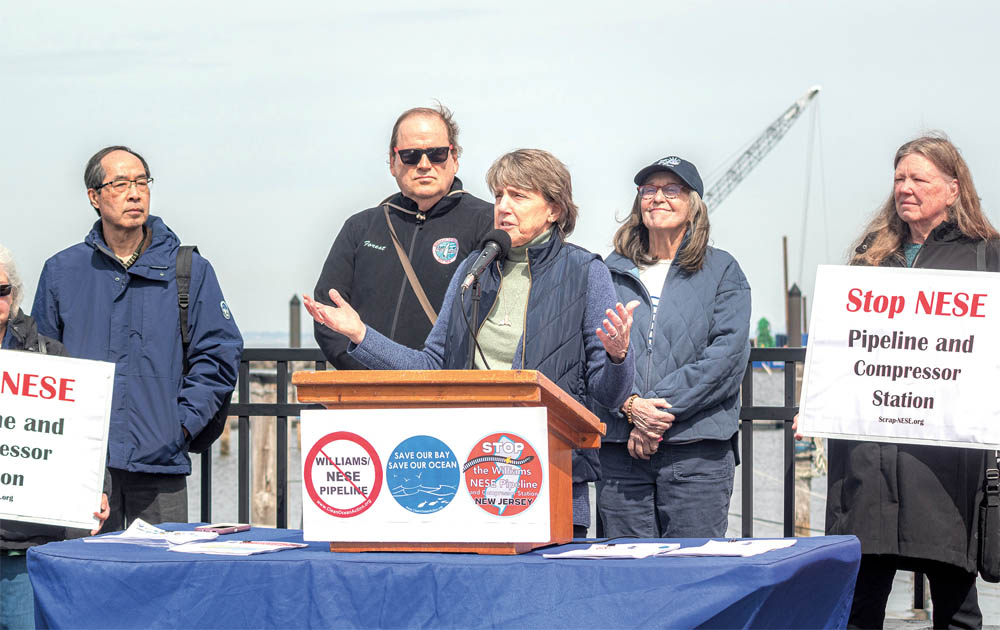
At a March 25 press conference at the Atlantic Highlands marina, several members of the public, local officials and nonprofit organizers spoke out against NESE. Those in opposition noted impacts on marine and aquatic habitats and wildlife, as well as health concerns for residents in Franklin Township near the proposed compressor station. A major concern is the resuspension of toxic particles in the water, such as copper, lead, mercury and zinc, during the pipeline’s construction.
In addition to concerns about NESE’s environmental and public health impacts, there are also concerns that this pipeline could be a catalyst for even more development off the coast of New Jersey.
Bigger Than a Pipeline
Two other projects that could be fueled by NESE’s approval also concern COA.
Empire Wind is an offshore wind project being built by Equinor, a Norwegian-based energy company. The project is being developed in two phases. Phase One of the project, dubbed Empire Wind 1, will be located 15 to 30 miles southeast of Long Island and, when completed “will deliver 810 MW of energy into Brooklyn, powering 500,000 New York homes,” according to the project’s website, empirewind.com.
“It has been widely reported that President Trump and New York Gov. Kathy Hochul have struck a deal for the Northeast Supply Enhancement (NESE) pipeline to be built in return for federal support of the Empire Wind 1 Offshore Wind construction,” reads a statement on COA’s website. The Trump Administration issued stop-work orders for offshore wind projects in 2025.
While Hochul never publicly confirmed any deal, the White House stated in 2025 that Hochul “caved” and agreed to allow “two natural gas pipelines to advance,” according to a published report by E&E News, the energy and environment division of Politico, a political news website. It was “widely reported and bragged about from the White House that this was a deal,” Zipf said. This is “a project that we have raised significant concerns about,” she said. COA, alongside Protect Our Coast New Jersey and ACK for Whales, filed a lawsuit in June 2025 targeting Equinor’s Empire Wind project to reinstate a stop-work order imposed by the federal government earlier that year.
Another project that could be affected by NESE’s progress is Port Ambrose, a proposed offshore liquefied natural gas facility located at the gateway to the NY/NJ Harbor, approximately 28 miles off Sandy Hook. COA and other environmental groups fought the $600 million facility, which was shut down in November 2015 by former New York Gov. Andrew Cuomo.
One of the potential risks of NESE, Zipf fears, is that its construction could revive the Port Ambrose project or similar projects. A pipeline, “especially one deemed unnecessary by independent sources… could tee-up the opportunity for another proposal for another liquefied natural gas facility,” Zipf said. There has been a debate between supporters and critics of NESE for years over whether the pipeline is truly needed to meet New York’s energy demands.
In the meantime, if the COA lawsuit follows the “natural course,” it could be months until a major development, according to Provence.
As of July 28, no stop-work order has been issued for NESE, so Williams/Transco could legally start digging in the bay.
“Anything they do is at their own risk,” Provence said.
The article originally appeared in the July 30 – August 5, 2026 print edition of The Two River Times.