By Sunayana Prabhu
RED BANK – Rising property values may have created a housing challenge for many, but it is a crisis for those facing racial and financial discrimination.
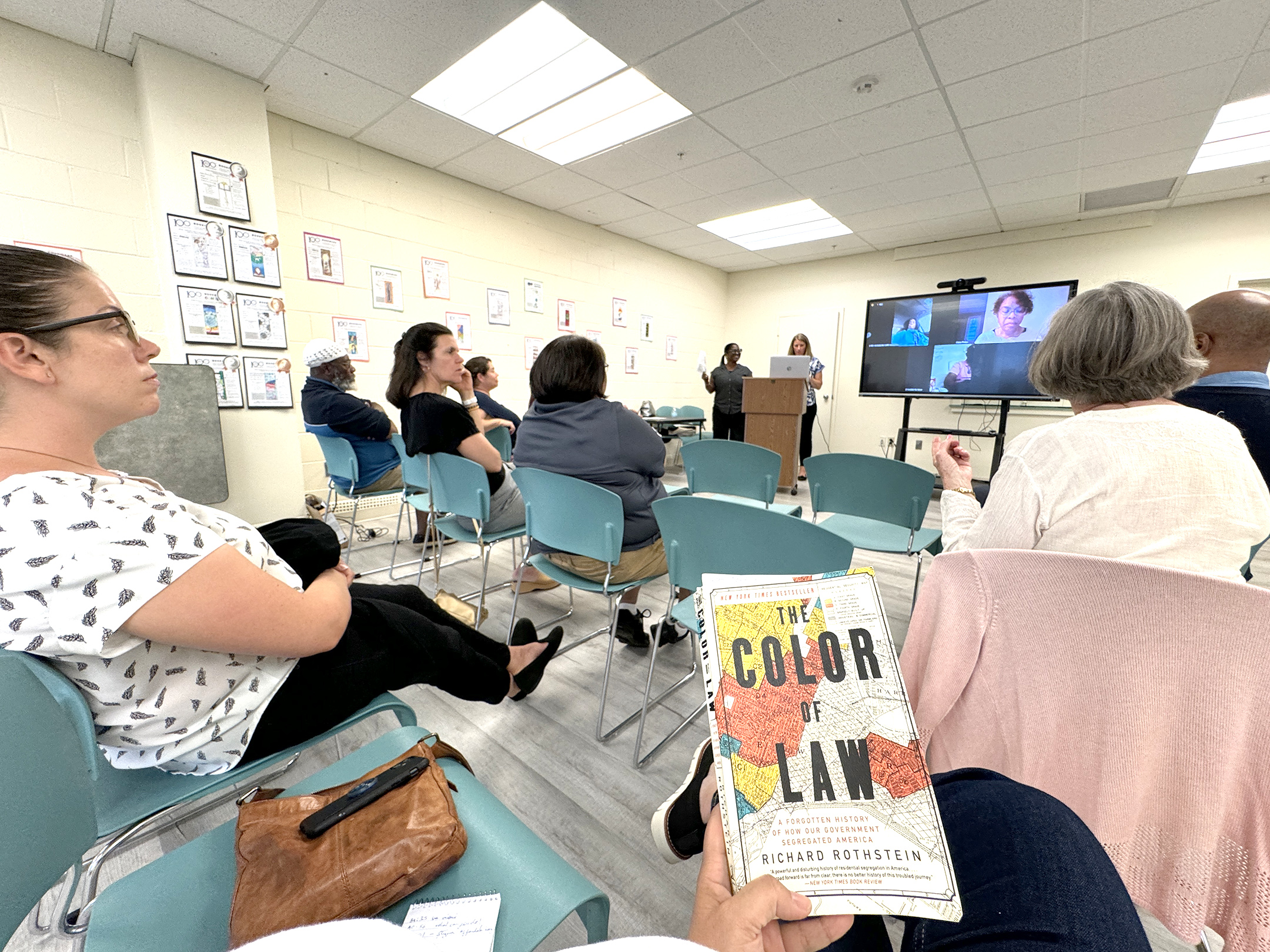
Championing affordable housing solutions in New Jersey, the Red Bank Public Library (RBPL) hosted its latest “Let’s Talk About Race” series May 28, in person and online via Zoom.
Randi Moore and Toi Collins, representatives from the Affordable Housing Alliance (AHA), educated nearly a dozen attendees about the state’s highly debated fair share housing policy against a historic framework of racial segregation embedded in the Constitution that fuels the housing crisis to this day.
“The Color of Law: A Forgotten History of How Our Government Segregated America” by Richard Rothstein was a big part of the discussion. Moore and Collins, as well as Patty Whyte, coordinator of RBPL’s Let’s Talk About Race program, highly recommended the book, which explains redlining, a discriminatory practice in which the government would literally draw red lines around areas on maps, typically black neighborhoods, and refuse to insure mortgages or back loans in those communities. This made it nearly impossible for Black residents, including those who could afford homes, to obtain loans and often led to disinvestment and decline in redlined areas over time. It promoted racial segregation and unequal access to wealth-building through homeownership along racial lines.
Redlining was outlawed in 1968, but its legacy of segregation, wealth gaps and barriers to affordable housing opportunities persists today in many communities “because it has now set the pattern,” noted Whyte.
“You’ve probably heard the story,” she said. “A black couple will go apply for a mortgage or a rental and they get turned down. A white couple with the exact same demographics, same income, when they apply, they get it. There’s your evidence. But it is hard to prove, and nowadays, it’s not always about race.”
The presentation by Moore and Collins highlighted how racial discrimination in homeownership impacted communities: Statistics showed black and Latino families’ median net wealth is a fraction of white families.
“We believe housing is a human right,” Moore, the CEO of AHA, said, emphasizing that everybody deserves to feel safe and secure in their housing. “We recognize the impact of discriminatory housing practices like redlining and what that has caused in our communities.”
AHA is a Neptune-based nonprofit established in 1991 to address the overwhelming need for affordable housing in Monmouth County. In the past 30 years, AHA has developed over 600 affordable homes in Monmouth County and continues to manage around 400 of those. However, even after decades of work, “there’s still a huge need for affordable housing here,” said Moore.
What is Affordable Housing?
Collins defined affordable housing as “housing in which the applicant pays no more than 30% of their income towards housing costs.” Depending on the applicant’s income, there are several types of housing options, broadly classified into project-based housing and tenant-based housing.
Project-based housing is subsidized during construction or acquisition and underwritten so the affordable rent can sustain the property. Tenant-based housing vouchers are part of the Housing Choice Voucher Program, also known as the Section 8 program. It is federally funded and administered through state and local housing authorities.
To be eligible for affordable homes, an applicant’s income must be below 50% of the area median income (AMI). In Monmouth County, the AMI is about $65,300 for a family of four, so to qualify for affordable housing, that family would have to earn less than about $32,650 a year.
The speakers cited a report from the National Low Income Housing Coalition that ranked New Jersey seventh on the list of least affordable states. According to the coalition’s latest report, the dearth of affordable housing has caused a statewide housing crisis, with over 50% of households cost-burdened and 276,000 additional rental homes needed.
A single-day survey done by the coalition last year found that “over 10,000” people were homeless statewide and 483 individuals in Monmouth County alone were identified as living in shelters or unsheltered locations, like on the streets, in cars or in makeshift camps. These numbers are likely “an undercount,” Moore cautioned, as some people who are homeless may be harder to find in a single day.
Deceptive Discrimination
Housing discrimination is illegal in all private and public transactions but those seeking affordable housing are still more vulnerable to prevalent racial biases and dishonest practices.
New Jersey state law prohibits landlords from denying a voucher, but landlords still do so to get a higher rent, which is discriminatory, said Moore. The U.S. Department of Housing and Urban Development (HUD) estimates gross rent within an area to determine rental caps and subsidies, mostly for tenant-based vouchers. The 2024 fair market rate determined by HUD for a two-bedroom rental in Red Bank is about $2,190.
Housing discrimination these days is “silent” and “not as blatant as it used to be,” said Collins, noting actions like real estate appraisal discrimination. “If the appraiser knew that you were African American, then they give a lower price for your house versus a person who was white.”
All housing discrimination complaints can be reported to the Division of Civil Rights (DCA) or the Monmouth County Fair Housing office.
Government Policies on Affordable Housing
The race talk shed light on New Jersey’s unique position in fulfilling affordable housing requirements through a legal mandate called the Mount Laurel ruling.
The ruling stemmed from a lawsuit brought by residents in Mount Laurel Township who wanted to build affordable housing but were blocked by restrictive zoning laws. In 1975, the New Jersey Supreme Court ruled in Mount Laurel I that municipalities have a constitutional obligation to provide a fair share of affordable housing opportunities.
This established the Mount Laurel Doctrine, which requires towns to eliminate unnecessary zoning barriers that prevent affordable housing and develop plans to meet fair share obligations. In 1983, Mount Laurel II provided more guidance on calculating fair shares based on regional needs and a town’s capacity to grow.
However, enforcement proved challenging.
In 1985, the Legislature established the Council on Affordable Housing (COAH) to set municipal obligations and oversee compliance. However, over time, only about half of the projected need was actually developed. Disputes also arose over tactics like Regional Contribution Agreements (RCA) which allowed wealthier towns to transfer obligations elsewhere. “Often more wealthy towns that didn’t want to build affordable housing in their towns would pay other towns to take their obligation. What they paid generally was not enough to actually build that housing, but it was something to get out of their obligation,” said Moore. RCA ended in 2008.
By 2015, the state Supreme Court transferred jurisdiction over cases to local courts due to ongoing arguments.
“Despite all the Mount Laurel rulings and all of the things that we have existing in our state, we’re still one of the most racially segregated states in the country,” Moore said.
The newly amended Fair Housing Act of 2024 aims to reset the process through a centralized board and regional targets, but the full impact remains to be seen as rules are still being established.
“In a community like Monmouth County, it’s tough,” Moore said.
“There isn’t a lot of space and it can be very expensive.”
The Monmouth County Board of County Commissioners opened a pre-application process for the Rental Assistance Housing Choice Vouchers (HCV) program lottery, available online until June 7.
Applicants not selected for the lottery are encouraged to contact the Monmouth ACTS Navigation Hotline for resources to help low-income families, seniors and those with disabilities find safe, sanitary housing in Monmouth County.
Residents Can Steer Change
“Make sure you are part of the solution,” Moore urged, suggesting residents support developers when affordable projects are proposed. Standing up for housing equity also means combating the stigma around affordable housing – the NIMBY or “not-in-my-backyard” mentality – said Moore, adding that she lives beside public housing with “the most wonderful neighbors.”
Affordable housing “can actually increase the property values when done correctly.”
Attendees of the talk discussed local housing issues as well. Fair Haven resident Kristina Nash said the presentation was “eye-opening” and she plans to research obligations around affordable housing in her town, which has hardly any affordable rentals. “I almost wish they could come present to our city council,” Nash said.
“It’s hard to even address it (housing discrimination) in a single conversation,” Whyte said. “All the laws in the world haven’t really” created more inclusive communities, she noted, something that won’t happen “until people change their hearts.”
The article originally appeared in the June 6 – June 12, 2024 print edition of The Two River Times.