April is National Stress Awareness Month
By Marirose Krall
Feeling on edge? You’re not alone. That sense of anxiety has become pervasive across all segments of society, and it appears to be growing. Vivian Onuro, M.D., an internist at
RWJBarnabas Health in Eatontown, has noticed an uptick in the stress levels of her patients. “While stress has always been a part of life, it seems to be elevated in modern life,” she said.
She cites data from the American Psychological Association, which states that 75% of Americans have reported emotional or physical symptoms of stress, with 49% experiencing considerable daily stress. “That means one out of every two people walking around is under significant stress,” she said.
Onuro, who is from the Republic of Ghana, feels that this is notably evident in the United States. “If you’ve not traveled, you won’t understand how the systems here make it physically impossible not to be stressed. I didn’t know the meaning of stress until I got here.”
Modern stressors come in various forms: financial difficulties, work-related issues, political polarization, health challenges, interpersonal relationship problems and the ubiquity of social media and its constant newsfeed of events, both good and bad.
And all that stress can take a toll on the body. According to the National Center for Complementary and Integrative Health (part of the National Institutes of Health), “Occasional stress is a normal coping mechanism. However, long-term stress… may contribute to or worsen a range of health problems including digestive disorders, headaches, sleep disorders, and other symptoms. Stress may worsen asthma and has been linked to depression, anxiety, and other mental illnesses.”
While stress-inducing situations are unavoidable, there are ways to mitigate their effects on your health and well-being.
In-the-Moment Techniques
When faced with a tense situation, Onuro suggests quick, immediate practices that can help moderate your response. “You can concentrate on your breathing,” she said. “Take deep breaths to help you relax.” She also recommends using guided imagery. “Close your eyes and imagine yourself in your happy place, whatever that means to you. That can help you refocus your attention away from your stress.”
Lifestyle Tactics
Still, managing stress can be most impactful when it’s a lifestyle choice. You can keep stress at bay consistently by incorporating certain habits into your routine regularly.
Onuro noted that a meditation practice can be beneficial in reducing stress levels. “Practice mindfulness; you have to actively be in the moment.”
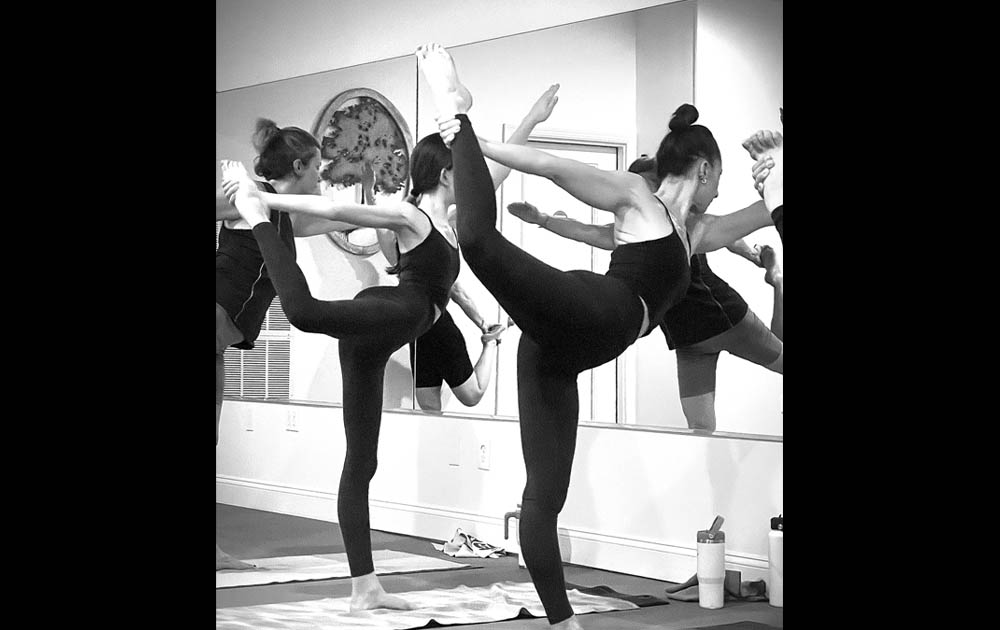
One way to meditate is through yoga. Ginna Turnamian, who has been practicing yoga for over 25 years, agreed. “I had a very demanding job in fashion during my 20s that led me to yoga. I’ve been a dedicated practitioner ever since.” In 2011, Turnamian opened her own studio, Hot & Soul Yoga, which now has locations in Middletown and Colts Neck.
Turnamian suggests repetitive practice for clearing the mind. “Our ‘Hot 26’ class, inspired by the Bikram Method, is a moving meditation. It’s always the same 26 postures; that’s why I’m so drawn to it. I can put myself on autopilot and get into a meditative zone.”
Practicing yoga has improved Turnamian’s life in myriad ways. “It’s helped me navigate a very stressful career and personal life. It helps me manage running two businesses, oversee a staff of 16 and act as head of a household. It’s the glue that holds me together. It gives me a solid foundation to handle all those branches in a non-chaotic manner. It’s saved my life for the last 26 years.”
Engaging in favorite pastimes such as painting, gardening or baking is another way to alleviate stress. Alicia Muelensteen describes how knitting affects her mood. “It allows me to pursue some creativity, and I learned along the way that it’s a good stress reliever.” Muelensteen, owner of Monmouth County-based Two River Fiber, which sells New Jersey-sourced yarn, shared that her hobby has helped get her through some tricky times in her role leading membership teams at large nonprofits. “I used to knit an annual ‘budget-time sweater.’ If it was a bad budgeting season, I would knit a second one,” she said with a laugh.
There’s a good reason why knitting can be soothing. “You have to pay a certain amount of attention,” Muelensteen explained. “It forces you not to multitask. There’s repetition to it; it can become a meditative movement. There’s something about the repetitive motion of your hands, feeling the tactile nature of the yarn that can calm you down.”
Social Support
A strong social network can also boost your resilience to stress. Spend time with friends or family, join a club or simply, Onuro said, “Get a hug from a loved one. During stress, our bodies release cortisol. Hugs encourage the release of oxytocin, the ‘happy hormone,’ which can offset cortisol’s effects.”
Outside Help
If dealing with daily pressures becomes an overwhelming struggle, it may be a good idea to seek medical or psychological help. The Mental Health Association of Monmouth offers resources on its website at mentalhealthmonmouth.org. RWJBarnabas Health offers The Center for Behavioral Wellness at Monmouth Medical Center. Visit rwjbh.org/monmouth-medical-center for more information.
The article originally appeared in the April 2 – 8, 2026 print edition of The Two River Times.