By Sunayana Prabhu
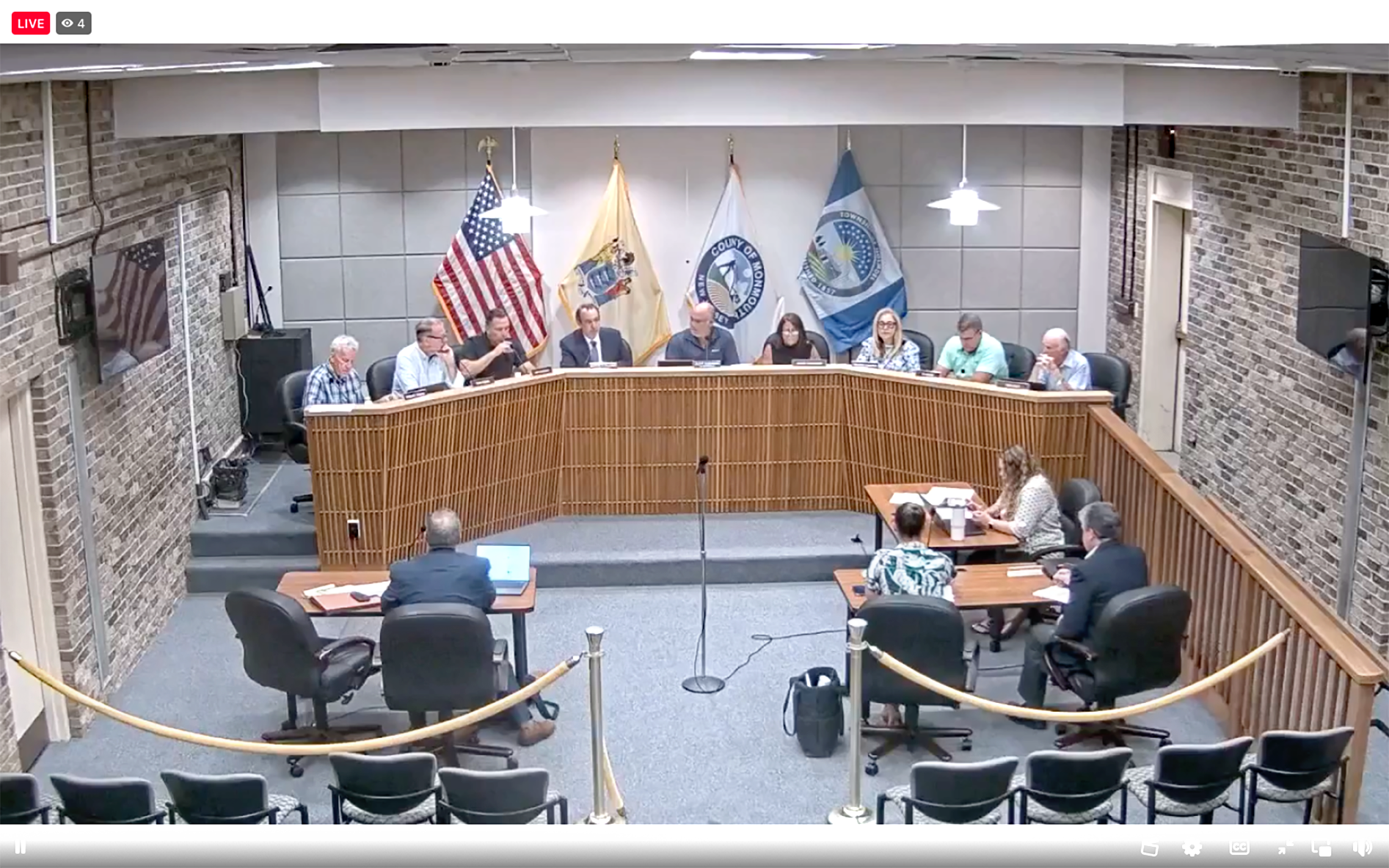
HOLMDEL – At a special meeting July 30 the township planning board voted unanimously to recommend to the township committee, that the site of the former Vonage property at 23 Main St. be declared a “non-condemnation area in need of redevelopment,” setting the stage for potential redevelopment.
At the meeting, the planning board reviewed a report on a preliminary investigation of the Vonage site prepared by Christine Bell, a licensed professional planner with the Neptune-based consulting engineering firm Leon S. Avakian Inc.
The report was commissioned by Holmdel Township officials in November 2023, to determine whether the former Vonage office building should be designated as an “area in need of redevelopment” for non-condemnation purposes, which means that the property cannot be condemned or taken by eminent domain.
The 350,000-square-foot corporate building, located on nearly 88 acres has sat largely vacant since the COVID-19 pandemic, when Vonage, a cloud communications company, moved into the Bell Works complex on Crawford Corner Road. Vonage had a lease for approximately “1/6th of the building that expired in January of 2024. It’s been vacant since that time,” noted Bell.
Discussions concerning the future of the site involved some complex considerations for the planning board.
“We reviewed the study area to determine if it met the statutory requirements of an area in need of redevelopment without condemnation,” Bell said. “We found that it met criteria A and B for an area in need of redevelopment.”
Bell noted Criteria A requires that the buildings on the site are mostly “substandard and unsanitary, dilapidated or obsolescence or possess any of such characteristics or so lacking in light air or space as to be conducive to unwholesome living or working conditions.” Criteria B refers to “the discontinuance of the use of buildings previously used for commercial manufacturing or industrial purposes; the abandonment of such buildings or the same being allowed to fall into such great state of disrepair as to be untenable.”
Bell said that as a result of successful tax appeals, tax assessments on the property reflect a “dramatic decrease in the value of the site” in recent years, dropping from nearly $35 million in 2022 to $22.75 million in 2023.
Tax data showed that the property has “not had a full lease of this site in quite some time,” said Bell, which qualifies it under established criteria to be designated an area in need of redevelopment.
A changing real estate market and a drop in the demand for office space “really drastically changed within the last four years,” Bell said. She argued that the use of large of fice buildings has been declining, trending toward “a smaller office space because people are working hybrid or remote (and) are not coming in every day.”
The Vonage property occupies one of the largest parcels in the township along Route 520, wrapping around Holmdel Road on the east and Route 34 on the west.
During the meeting, board members and residents brought up several concerns regarding the current condition of the property and its potential impact on the community.
Planning board member Wes Fagan asked Bell about the status of an onsite sewage treatment plant that he estimated was built in 1977 and which he said was “a unique component of this property.”
“I’ve heard that it has not met the standards of what a modern sewage treatment plant would be and, further, it discharges directly into a category-1 stream,” Fagan said, referring to the plant’s proximity to the state-designated Willow Brook, a category-1 freshwater stream that feeds into the Swimming River Reservoir. The reservoir is a source of drinking water for area residents.
Township engineer Bob Yuro said that the treatment plant is regulated by the New Jersey Department of Environmental Protection (NJDEP) and is “continually being monitored right now.” Although Yuro confirmed that it “does discharge directly into the C-1 category stream, he emphasized that “it is permitted by the DEP. It is currently being maintained to the current standards. The permit is current and the (sewage treatment) package plant in its current condition is operational and acceptable to the state.”
Fagan further inquired if the packaging plant was in “disrepair” and whether the plant “as it stands now is adequate or would you recommend a new packet?”
“I could not say that without knowing what’s going to be built there,” replied Yuro, but “more than likely” the current sewage plant would stay in operation if “it’s of lesser use” than what it was designed for. However, the developer would have to go back to the NJDEP for an amended permit if the use “is more intense, that the system cannot handle it.” Yuro said it was “up to the DEP” whether they approve or deny any kind of expansion to that sewage plant because of the regulated discharge into the protected stream.
Planning board member Ron Emma also pushed back on designating the area for redevelopment based on tax appeals. “Just because they file a tax appeal and they win doesn’t mean it’s not rentable,” he said the same argument could be true about Bell Works which “may not be 90% full but it’s 90% leased and rents are through the roof in that building,” he argued that there may be a need for a redevelopment project like Bell Works, instead of a new developer taking over.
The board members also discussed some advantages to the redevelopment such as tax benefits to the township, meeting the affordable housing requirements, and smart growth goals for the township, among others.
Residents had mixed reactions to the planning board’s decision. Resident Jay Yannello echoed Emma’s argument and said he walked around the building. “It’s in pretty good shape. It’s actually pretty cool inside,” Yannello said. The idea to suggest this building is not being used to its capacity, he said, “is just complete nonsense.”
Contrarily, resident Patrick Trischetta said that “the building is grossly outdated.” He added, “Nobody, no corporation builds 350,000 square foot office space anymore. I agree with the planner. This area clearly needs to be redeveloped into something that’s useful to Holmdel,” Trischetta said. “Redevelopment times have changed.”
According to Trischetta, when he came to Holmdel 41 years ago, the Prudential Insurance Company was the “major employer and a major taxpayer to Holmdel. Two thousand people worked there weekdays. It couldn’t compare with the Bell Works, where 7,000 people work.”
As the redevelopment process moves forward, the township officials plan to weigh the various factors and engage with the public to ensure that any redevelopment plan aligns with Holmdel Township’s aesthetics and the community’s goals and vision for the future before adopting a final plan.
The article originally appeared in the August 8 – 14, 2024 print edition of The Two River Times.