By Sunayana Prabhu
HOLMDEL – Riding the recent success establishing the 35-acre Dr. Robert Wilson Park to preserve the legendary Holmdel Horn on Crawford Hill, the township committee has dived into another, much larger parcel that could hold just as much promise – and pride – for both residents and officials this election year.
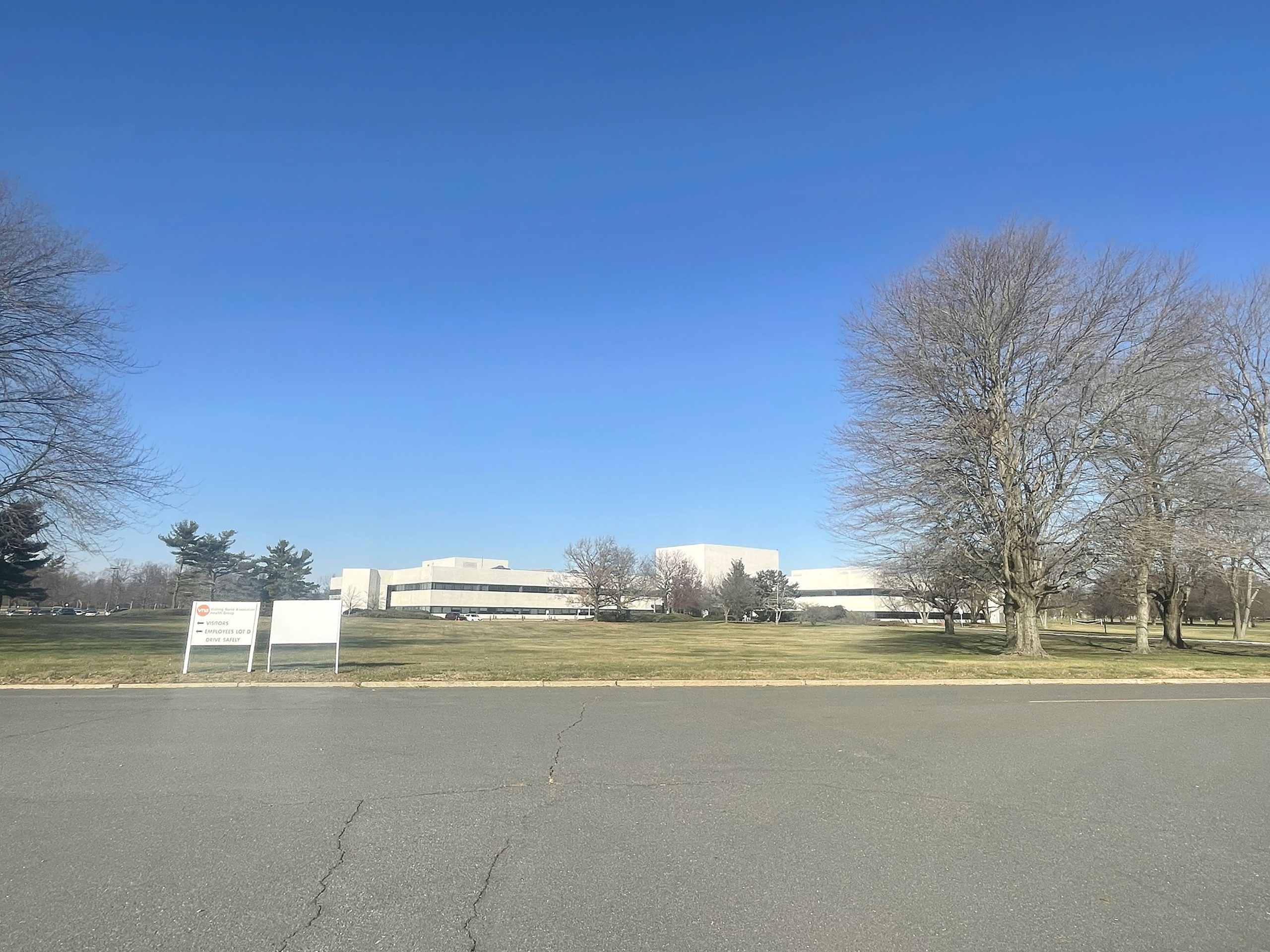
The 88-acre site at 23 Main St., once occupied by global telecommunications company Vonage, is one of the largest parcels in the township. Its future took up a significant chunk of the township committee’s June 11 meeting.
Mayor Rocco Impreveduto opened the meeting with an update from the recently established ad hoc redevelopment and economic advisory committee, a nine-member group of residents and township officials formed to provide inputs on potential development or redevelopment issues in the township now focused on the future of the Vonage property.
Busy roads border the southern Holmdel parcel on three sides: CR 520/ Newman Springs Road on the south, CR 34 on the west, and Holmdel Road on the east. Eric Silvergold, chair of the redevelopment committee and also the township’s finance committee, provided background on the site and a presentation outlining options the committee has evaluated.
The 350,000-square-foot building on the property, currently zoned for office or laboratory uses, was built in 1977 for Prudential’s Property & Casualty business. According to Silvergold’s presentation, the property was sold to Mack-Cali for $23.75 million in 2005. Vonage leased the property as its headquarters until the company was acquired by Ericsson in 2022 and moved to Bell Works. In 2023, Mack-Cali, now known as Veris Residential, sold the vacant property to CHA Partners for $17.5 million.
The office complex has largely sat empty since the telecommunications company departed in 2022, leaving questions about potential new uses and causing a steady drop in township tax revenue and the property’s value.
“There’s a 26% decline in the value of the property based on actual sale data points since 2005,” Silvergold noted.
The property was assessed at $36.7 million in 2020 but generated around $600,000 in annual property tax revenue. In April, the property owner appealed the assessments for 2022 and 2023 and won a reduction. The 2022 assessment was lowered 32% to $24.8 million, and the 2023 assessment was lowered 38% to $22.75 million.
Silvergold noted the property’s assessed value has declined 44% since 2020. “The implication of that for Holmdel is that we’ll have our revenues reduced by approximately $218,000 per annum,” said Silvergold.
He cited factors like an outdated building, higher interest rates and decreased demand for office space post-pandemic as reasons for the declining property values and assessments, seen not just in Holmdel but across suburban office markets.
The committee created a matrix for the presentation to illustrate each of the eight potential redevelopment options using nine criteria detailed below.
The eight redevelopment concepts were: a continuing care retirement community; a data center that would house information technology applications; an open space/ public park; low-density single-family luxury homes that would be conceptually similar to the Reserve development next to Bell Works; a higher-education college campus that could serve as a major satellite facility for an existing college or university or a single smaller institution with no dorms on-site; co-working space rentals; an indoor recreation facility similar to Lifetime in Middletown; a luxury active adult (55+) community similar to Regency at Bell Works.
Each redevelopment option was assessed based on its impact on the environment; runoff/stormwater patterns; traffic; utilities; the school district; township revenues; local economic development; police, fire, EMS and public works infrastructure; and Holmdel’s unique character and aesthetics.
From these qualitative evaluations, preserving the land as a public park or open space emerged as the committee’s preferred, though financially challenging, option. Silvergold called it “a rather desirable outcome for the citizens” that “would also be prohibitively expensive and probably difficult to pull off.”
Adapting the existing office building for co-working rentals or indoor recreation can be considered but its footprint is small considering the overall size of the property, Silvergold said. This option would have to be “worked into a mixed-use solution that combines multiple options.”
The prospects of a higher education satellite campus or data center scored well due to the minimal modifications required. Lower on the list of preferred uses were single-family luxury homes, active adult communities for residents over 55, and continuing care retirement communities. “These options would require greater scrutiny and analysis given long-term impacts,” Silvergold said.
Silvergold suggested “a mixed-use development option” may be most viable given financial realities, alluding to a mix of residential, commercial and recreational use similar to the benchmark set by the Bell Works redevelopment.
As other suburban office centers decline nationwide due to outdated buildings, higher interest rates, and decreased office demand since the pandemic, creative solutions are needed to sustain such properties in the long term. “The way suburban office centers are going across the country, the decline in value that you see here, that’s pretty consistent with the space everywhere,” he noted.
The presentation was “really just to describe so far where we stand to date,” Silvergold clarified. The committee’s work outlines both aspirations and constraints shaping potential redevelopment of the key township property. “All of this can change. This is not, just to be crystal clear, a recommendation,” Silvergold stressed. The committee plans continued evaluation as specific proposals emerge.
During an open question period, resident Karen Strickland asked whether the township had the “flexibility” to do with the property what citizens would like “versus the guy who owns the property.”
Township attorney Mike Collins noted the process would mirror the one the committee followed for the Crawford Hill redevelopment – direct negotiations among officials, owners and developers.
“With a project like that, we look to find the best possible option in partnership with the owner,” Impreveduto added.
While the committee provided objective assessments, no decisions have been made on future use. Impreveduto said feedback from residents and the committee will guide discussions with property owners as options crystallize. However, Impreveduto said, whatever option is finalized, “it’s going to have to be within the aesthetic of the culture that we set for the town.”
The article originally appeared in the June 20 – June 26, 2024 print edition of The Two River Times.