By Sunayana Prabhu
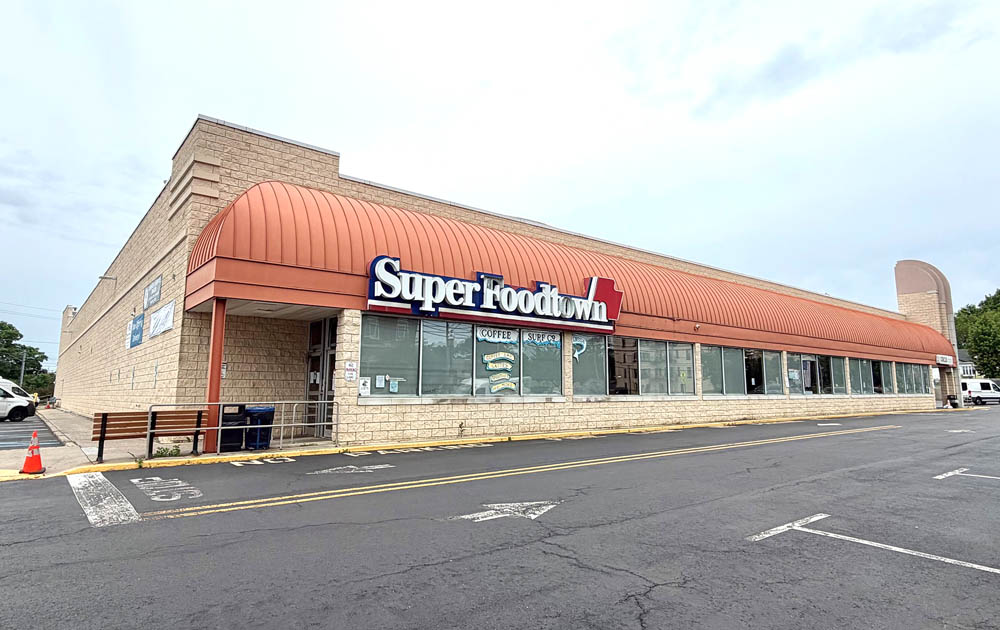
RED BANK – Developer Roger Mumford is under contract to purchase the Atlantic Club site on Maple Avenue; the club is relocating into Super Foodtown’s building following the store’s recent closure. The major reshuffling of uses is set to launch redevelopment at the intersection of Broad Street and Maple Avenue (Route 35), potentially redefining one of Red Bank’s most highly visible and busiest intersections.
Mumford, who owns about 15 adjoining parcels near the intersection of Maple Avenue and Broad Street, is now advancing plans for a new townhome community at the site. “We understand that the Atlantic Club will be acquiring the Foodtown and making substantial improvements to create a world-class fitness and spa,” Mumford said in an interview May 22. He also confirmed his undercontract purchase of the Atlantic Club property and his plans to submit a development application to the borough within the next 60 days.
The triangular piece of land totals about 7 acres, including the former Foodtown property and the 15 parcels owned by Mumford located mostly along Wikoff Place. The Foodtown property sits at the southern tip of the proposed redevelopment with entry and exit points from both Broad Street and Maple Avenue.
The Atlantic Club property and multiple residences – most prominently the historic “Mushroom House” – occupy the bulk of the parcels proposed for redevelopment.
Mumford said his team has been performing engineering and design work for over a year and anticipates submitting a fully detailed project for review in the next five to six weeks. The proposed new development is not going to be “a typical townhome community,” Mumford said, adding that his plans are less dense than some recent Red Bank developments and architecturally distinctive, aligned with the borough’s guidelines.
“Our plan is to submit an application for a townhome community that is going to be built in a Second Empire style to capture some of the richer architectural aspects of Red Bank,” he said.
Mumford restored the historic T. Thomas Fortune Cultural Center on Drs. James Parker Boulevard in 2019, also in the Second Empire style, keeping the characteristic mansard roof and arched doorway. That building dates to 1870 and served as the Fortune family residence in the early 19th century. Mumford acquired the house in 2016 and donated the rehabilitated home as a cultural center in conjunction with subdividing the property to develop Fortune Square, 31 rental residences designed in the same 19th-century style as the cultural center.
Mumford is also meeting with the borough’s Historic Preservation Commission to discuss how the new community could reflect and preserve existing architectural elements, including the “Mushroom House” and property on Broad Street that has distinctive stone mushroom-style elements.
Plans for the new community include using “real stone, not artificial walls, maybe two-foot high, and there will be mushroom caps, it’ll all be handmade by stone masons,” Mumford said.
Additional projects built by Mumford in town include the recently completed Azalea Gardens townhome community on the corner of Harding Road and Hudson Avenue, the Brownstones townhouse development on Catherine Street, Station Place apartments on Monmouth Street and Oakland Square apartments on Oakland Street.
The new townhome proposal near Maple and Broad is intended to “be completely unique,” he said. “It’s not going to be like the townhomes you see in Fort Monmouth, or Freehold, or Middletown.” The objective is to produce a project that is site-specific and long-lasting rather than a formulaic, mass-produced development. “We’ll do something beautiful,” Mumford said.
Mumford also dismissed reports of high-density plans for the location.
“I see some negative blogs that we’re going to build 9,000 townhomes and all this type of stuff. That’s absolutely not the case,” he said. “When you compare the density of what we’re doing to the new giant building by the river and other properties, we are a fraction of that kind of density.”
The plans include significantly reducing impervious coverage across the 15 parcels, adding landscape and environmentally friendly features in place of large, paved lots.
Traffic circulation is also a key piece of the concept. Mumford is proposing changes to Wikoff Place, a short, narrow roadway that feeds into Broad Street near the Pinckney Road intersection, with another opening on Maple Avenue.
“Wikoff is a dangerous road, most of it is oneway, it dumps out onto Broad Street, and it’s really dangerous because of its close proximity to Pinckney,” he said, adding that from “Day One” his plan envisioned eliminating Wikoff Place. With Atlantic Club, operated under lease by Genesis Health Clubs, a major private gym operator, now on the Foodtown side of the corridor, Mumford believes there is a better opportunity to reconfigure the intersection as part of a coordinated redevelopment. He said he is eager to review Genesis’ engineering plans for the gym property; the two holdings share about 700 feet of common boundary, he noted, which could allow for shared improvements that benefit both the residential community and the fitness club.
Mumford said he expects some opposition as formal plans reach the public stage but argued that the team is devoting substantial effort to ensure the project enhances Red Bank’s character.
The planned townhomes will be “reasonably priced,” he said, for the current market and predicted the project would be seen for years as architecturally distinct.
The article originally appeared in the May 28 – June 3, 2026 print edition of The Two River Times.