By Sunayana Prabhu
HOLMDEL – There is no denying that California still holds the title, but “Monmouth County, New Jersey is going to become Hollywood East,” predicts Rumson resident and producer George Kolber, whose recent film “Miranda’s Victim” was shot entirely in Monmouth County.
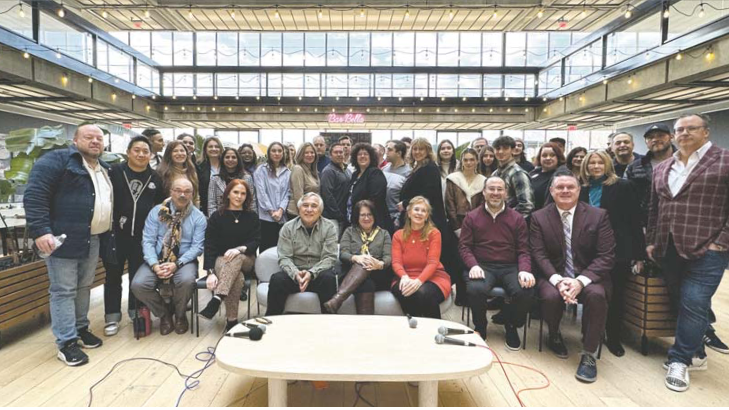
He made that optimistic statement at Bell Works in Holmdel Jan. 28 during the Let’s Talk Film In NJ event.
Organized by the Monmouth Regional Chamber of Commerce, the event was hosted by Terence Wall, co-founder of the ChamberCast podcast.
Kolber sat on a panel of film industry leaders from the area who showcased the Garden State’s rising prominence in film and television and discussed how Monmouth County could benefit from the burgeoning movie-making scene.
The event was livestreamed on social media with key speakers who included Diane Raver, executive director of the New Jersey Film Academy and founder of the Garden State Film Festival; David W. Schoner Jr., associate director of the New Jersey Motion Picture and Television Commission; Lauren Concar Sheehy, executive director of the Garden State Film Festival and senior video production specialist at Brookdale Television; Moshe Gross, CEO of Reset Locations; and Joan Ali Scocco, Ph.D., chief officer for strategic initiatives at Brookdale Community College.
Students, independent filmmakers, educators and business owners – including other participants like waste management company Mazza Recycling – were among nearly 50 attendees looking to make their mark in the regional film industry.
Netflix launched netflixnewjersey.com Jan. 28, its website dedicated to the new Netflix Studios Fort Monmouth. It will soon post job listings ahead of an expected 2028 opening to harness the workforce needed to meet the demands of the future landscape on the Jersey Shore.
A panel of industry experts shared their “reel-world” insights about what this might entail with young college students and experienced area business leaders
“You need to be doing something now,” Sheehy told the students. “Don’t just wait for college and then wait for after. You need to be involved. Now. I’d much rather hire somebody that has a job than somebody that might have learned to binge drink for four years.”
Sheehy explained that the film industry is “not just director and actor” – there is a wide range of career paths in the film industry that students need to be aware of. “If you love styling clothes, we have a fabulous program at Brookdale for fashion design,” she said.
“You can get into the wardrobe business.”
She noted that students are often pressured to decide their entire future by their junior year of high school. However, it’s important to explore and “try things out,” she said. Brookdale and the Garden State Film Festival aim to provide opportunities for all students.
“We’re here for students, no matter what age. We have internships, and it’s a really wonderful experience.”
Scocco spoke about New Jersey Film Academy’s collaborative efforts with nearly 13 community colleges, including Brookdale, to create a skilled workforce. The academy launched a program at the college’s Lincroft campus Dec. 4 and currently offers three credential tracks: production office and accounting; on-set production; and hair, makeup and wardrobe. Scocco discussed the value of acquiring academic credentials in addition to professional experience to find well-paying jobs in the industry.
Additionally, she said a New Jersey production guide being developed by the nonprofit arm of the Garden State Film Festival “will connect students to work, but not only that, vendors to people that need them, and the money that is raised there will go back out to scholarships so that we can take people and bring them into family-sustaining-wage jobs.”
In recent years, New Jersey has emerged as an increasingly attractive destination for film and television productions, mostly credited to a combination of generous tax incentives, diverse filming locations and a growing pool of skilled professionals. According to the state’s official website, qualified production companies can receive a transferable tax credit of up to 35% for some cast and crew salaries.
“Netflix is going to be, I believe, the largest studio complex in the country,” said Raver, “but they’re not the only game in town,” said Raver. The annual Garden State Film Festival, which she founded, will take place March 27 to 30 in Asbury Park and Cranford.
“New Jersey has an abundance of soundstages throughout the state – almost 70 in current operation (with another 70 to be completed by 2026),” according to the state’s website. New Jersey locations offer everything from small insert spaces to fully sound-proofed stages up to 36,000 square feet.
With New Jersey’s growing reputation, the influx of major productions and the investment in education and workforce development, Monmouth County has set the stage for a thriving production hub for several ancillary industries, from catering to real estate.
Moshe Gross, the CEO of Reset Locations, a company that specializes in brokering filming locations, has worked with productions like “Severance” and “Law & Order” at Bell Works. According to Gross, unique spaces in Monmouth County and the cooperation of local officials make it an attractive filming destination. The sentiment was echoed by Kolber, who experienced the ease of working in the Two River area firsthand while filming “Miranda’s Victim.” Apart from local catering and other services, more than 100 background actors from the area were employed during the filming, creating a busy gig economy.
“It won’t be long before we’re bigger than Hollywood,” Kolber said.
He is now exploring ways to bring the story of “Miranda’s Victim” to the stage as well. Kolber’s success is just one example of the industry’s growth in New Jersey.
Across the state, production companies are setting up shop, drawn by the promise of a thriving creative ecosystem and a supportive local community, the panelists said.
The article originally appeared in the February 13 – 19, 2025 print edition of The Two River Times